
🎧 Listen to this episode on Earth Witness | Apple Podcasts | Spotify
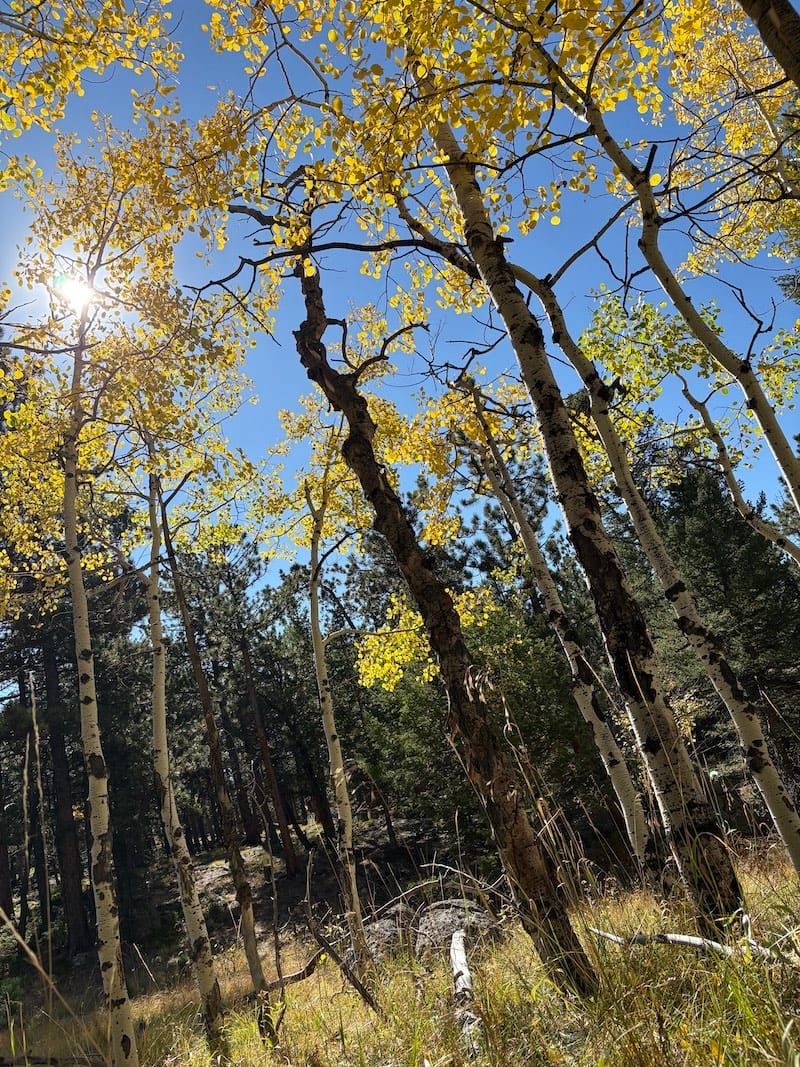
Deep in the mountains there is a beautiful aspen grove. It’s a special place, protected on all sides by rocky bluffs, fallen trees and steeply sloping pine woods, a gentle, tender hollow, like the solar plexus of the body. In spring the aspens shine brilliant green; in fall their leaves are flickering gold. When you enter the grove, passing between two tall trees standing like guardians, the noise of the outside world falls away. You hear only the minute rustle of leaves, the chittering of a chipmunk, the cawing of a raven as it flaps overhead.
At the very center of the grove there is a large, flat, and almost perfectly square boulder, fallen ages ago from the bluff. You may call it the vajrasana, the Diamond Seat. If you like you may sit here, back upright, and watch the earth revolve, watch the light turn the bluff pale vermillion, watch the seasons change and the snow fall and the flowers return. Here and there aspen boughs have fallen on the boulder and weathered in place, splintering and fracturing over many years, the gray wood grooved and whorled, like the stone speckled with pale green lichen, emerald moss, pine needles. To sit here even once is to join the great samadhi of the universe. To sit here is to be healed.
But: there’s no trail leading to the grove. If you stay on the path, you’ll never find it. This is why the Zen hermit Ryokan wrote, “No one ever finds this place / Only those who’ve lost their way.” (Great Fool, p. 138)
You may think the aspen grove here is just a metaphor, but not so. It’s a real place, which my girlfriend and I discovered one day while wandering in the mountains—really wandering, off trail, following the natural lay of the land. Sometimes this meant stumbling through low scratchy bushes, or squelching through marshy ground by a creek, or doubling back if the way was blocked by fallen trees.
At the time, we were still in a period of adjustment. I suppose we always are, in some sense, but I’m sure you know what I mean. While we had a good relationship, we still weren’t totally in accord. At times I would be taken aback at a comment I interpreted as critical or unfair, while I know she occasionally saw me as arrogant or overbearing. Once in a while, this uneasiness would erupt into a fight, one person or the other feeling wounded by some comment, or an impending decision weighing on us, or a needed change we couldn’t agree on.
Uncertainty filled the empty spaces. Where were we going? Was this really where we were meant to be, who we were meant to be with? We’d also had beautiful experiences, magical moments, a deep connection. But these didn’t override the anguish we felt when we were in conflict. Probably half a dozen times, in those early years, we were on the verge of breaking up, convinced we would never get along.
But something kept us going, some intuition, some sense of the love that was possible, a love that far surpassed any possibility of despair. We kept going. We kept wandering through the valleys and the brambles, and one sunny day in early summer the world opened and brought us to this special place, this grove, the heart grove.
And just like that, our concerns evaporated. Sitting amid the trees, seeing the face of my beloved radiant in the gentle sunshine, I loved her purely and truly and knew she felt the same.
Of course this doesn’t mean that we never have conflicts anymore. But the experience healed something in us. There’s a depth of love and harmony that, once felt, can never be doubted or forgotten. It may manifest most powerfully in our relationships, but ultimately it transcends them, or rather they rest within it, they rest within the grove.
There’s a saying that “Enlightenment is an accident, but practice makes you accident-prone.” The first part—“Enlightenment is an accident”—is a way of saying that you can’t use the self to gain freedom from the self; the result is always a stronger sense of self. You might, for instance, spend a decade studying texts on Buddhism and yoga, writing essays and developing complex theses, and at the end of that time, only have convinced yourself of your superior expertise. You’d be as far away from the true experience of reality as ever—further, even, than when you’d started.
Likewise, approaching meditation as a matter of muscular effort generates tremendous resistance. The more you tell yourself “I need to focus,” the more you’ll wander off into thoughts of your own superiority or inferiority, of success and failure. Enlightenment, as a goal, is infinitely elusive.
Far better to cultivate a balance, an upright back and a soft gaze, diligent but not forced. Early in the morning during retreat, for instance, we’re often sleepy, and so it may seem that we’re wasting our time, our minds just loosely drifting. But berating ourselves won’t help relieve our drowsiness, and drinking cup after cup of coffee will just leave us with a fidgety feeling and a full bladder. Instead, we steadily return to our practice, again and again. If we do this, we may find ourselves suddenly awake—really awake! I’ve had this exact experience, suddenly opening into samadhi from what was nearly a doze. It turns out that the liminal space of partial wakefulness can actually allow us to experience our consciousness free of discursive thought. Half-dreaming, we enter the waking dream of real life.
There are two ingredients here. The first is the place, or you might broadly say the conducive circumstances of time and space. The second is spontaneity. Precisely because we haven’t been chasing any particular experience, when we stumble upon it we find an unfeigned wonderment. The circumstances can be cultivated; spontaneity is much harder to come by. Douglas Adams had a hilarious way of putting this in The Hitchhiker’s Guide to the Galaxy when he wrote, “The secret to flying is to throw yourself at the ground and miss.”
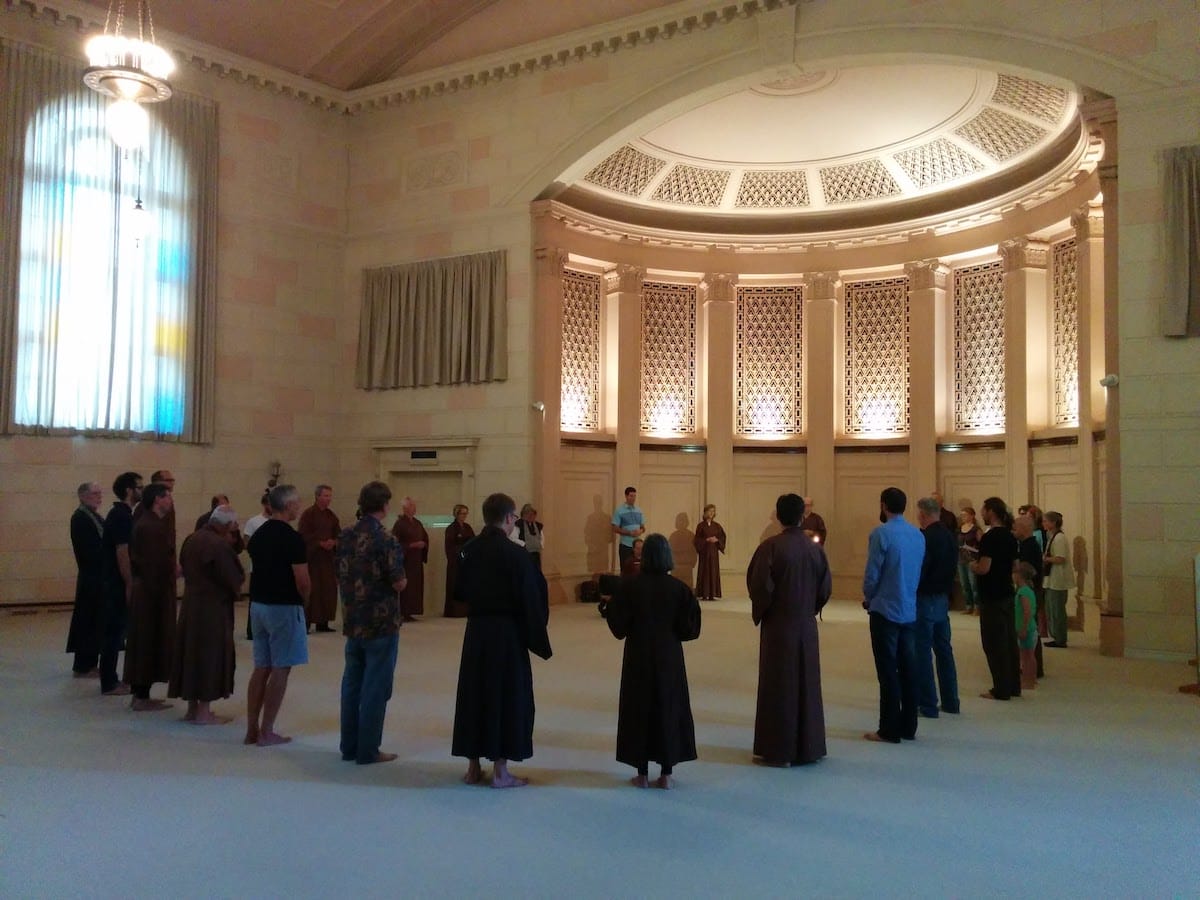
Of course, one can experience samadhi, or absorption, in nearly any place or circumstance. The former temple of the Zen Center of Denver was in an old Christian Science church. In many ways it was less than ideal for Zen practice, with thick walls, no clear windows (they were all colored glass), and no outdoor space, set right on Speer Boulevard with more or less constant traffic zooming by. Before the upper sanctuary was built, we sat in the basement, the zendo just a curtained-off square. Did that stop dozens or even hundreds of practitioners from having profound experiences there? Of course not. You can wake up as readily to the sound of a truck rumbling as a meadow lark singing.
Or can you? I do wonder about this. Zen teacher and author David Loy, among others, observes that in "urban environments especially, almost everything we perceive is a utensil" (Ecodharma, p. 6), a means to fulfill some human desire. Thus cities are monuments to desire, great manifestations of craving and thirst, right down to the stones in the garden. It’s only at the edges—weeds, empty lots, raccoons emerging from storm drains--that the untamed world sneaks in.
The Buddha himself lived and taught almost entirely outside. His enlightenment came while sitting under a great ficus, now often called a bodhi tree, at Bodh Gaya near Varanasi, and in early aniconic images, the Bodhi tree was synonymous with the Buddha.
Along similar lines, the early Buddhist sangha often practiced in groves of trees, and groves present a rich metaphor for the sangha. This metaphor became explicit in China, where the word for a Chan (Zen) monastery was cónglín, meaning “dense grove,” a term, to quote an academic paper on the subject, “metaphorically describing the harmonious communal life of monks, like trees growing densely together in a forest.” The denser the grove, the straighter the trees were said to grow.
The metaphor is especially apt with aspen groves, whose roots below ground are connected into great networks. What appear to be individual trees are actually part of a single organism. In just the same way, each of us may appear as individuals; but dig deeper, and we are all expressions of one nature, manifestations of the living whole.
As living beings ourselves, we often feel this connection most clearly in wild environments. You might not expect this to be the case. Garter snakes, dragonflies and wildflowers, after all, are about as different from us as can be, and their needs and desires may well conflict with our own. Shouldn’t we feel most connected in environments constructed for humans?
Yet the lived experience is exactly to the contrary. When we’re in nature, we feel more natural. The fresh air heightens our senses, the calls of wild things speak to our own wildness. With the human world left behind, we leave behind our human concerns, the repetitious whisper of I need that and What’s wrong with them and How can I make more. What does the sky or the ocean care about gain or loss? Amid expansive vistas, we’re reminded we are expansive. Beneath the night sky, we understand that our personal concerns really are insignificant, that we’re part of something much larger than ourselves, something beautiful and transcendent.
It turns out that a great deal of dukkha, of unease, is an artifact. It’s human-made. We build houses to fulfill our every desire and then feel trapped in those houses; we buy cars to race around in and then sit in traffic and yell at the vehicle in front of us.
Now, I don’t mean to hate on cities too much. I’ve lived in cities a good portion of my life—I live in central Denver now—and there’s plenty to recommend them. I love being able to see a world-famous band within walking distance of our house. Ironically, too, living in a city can be in some ways simpler than living rurally, since there tends to be much more available within walking distance, and more options for socializing and community.
But I do lament the lack of truly wild spaces. Denver does better than most, with extensive bike trails, large city parks and some wild space adjacent Cherry Creek and the Platte River. Even so, I dream of a city bold enough to replace even a small number of its streets with wildlife corridors.
Perhaps you too know a place like the heart grove, somewhere that speaks to you at a deep level. For all my critique, it might even be in a city. Just as many Zen Center members discovered profound awakening in a church basement, you might truly come to rest atop a high rise or on a favorite bench. On the other hand, this may be the exception that proves the rule. Places have power.
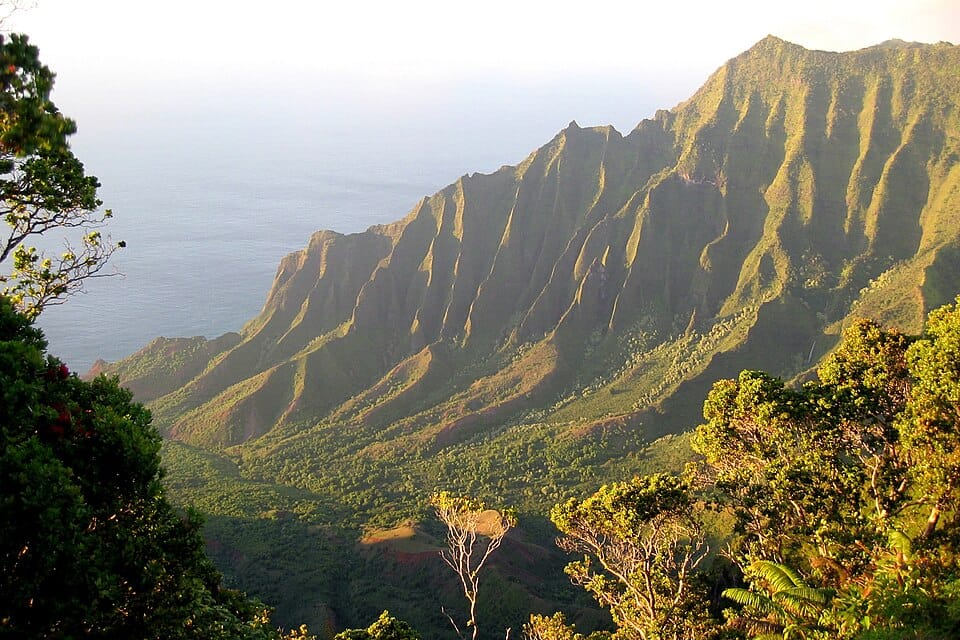
When I was fifteen years old, my father took me hiking on the Napali Coast, down into the valley of Miloli’i. The hike was arduous, dangerous even, creeping along narrow trails traced into the steep walls of the valley. The air was clear and the spaces vast, the ocean a huge presence below us. Down we went, switchback after switchback, finally descending a short rope into the green jungle of the valley floor.
We followed a stream to where it opened onto a white sand beach, the ocean waves lapping serenely on the shore. We were completely alone. That night the sky was perfectly clear and the stars were magnificent, clearer than I’ve ever seen them before or since, far from any human settlement. I lay gazing for hours.
To this day my father has a kind of little shrine to Miloli’i in his apartment, with a book full of photos and his shell collection. He speaks of it with a quiet longing and reverence. It is, I know, his heart grove—a place of perfect serenity and joy. That joy is amplified and deepened because he is able to share it with me. The land connects us.
People speak of ley lines and convergences. I don’t know about any of that, but I know memories like this can sustain us through our darkest days.
Nor is any memory just a memory. The waves at Miloli’i rise and fall with your own breath. The heart grove spreads its branches in your own chest. If you wander, you might just find it.
Member discussion: