
🎧 Listen to this episode on Earth Witness | Apple Podcasts | Spotify
Today we consider the fifth limb of the Noble Eightfold Path, samyag ajiva. Ajiva is cognate with Latin vivere (meaning “to live”) and thus to English words like “vital” and “vivid.” It is, in short, what you do to live, how you gain sustenance for yourself and offer it to others – physical, mental and spiritual. We read from the Dhammapada:
“As a bee gathers honey from the flower without injuring its color or fragrance, even so the sage goes on his alms-round in the village.”
– Ācāriya Buddharakkhita
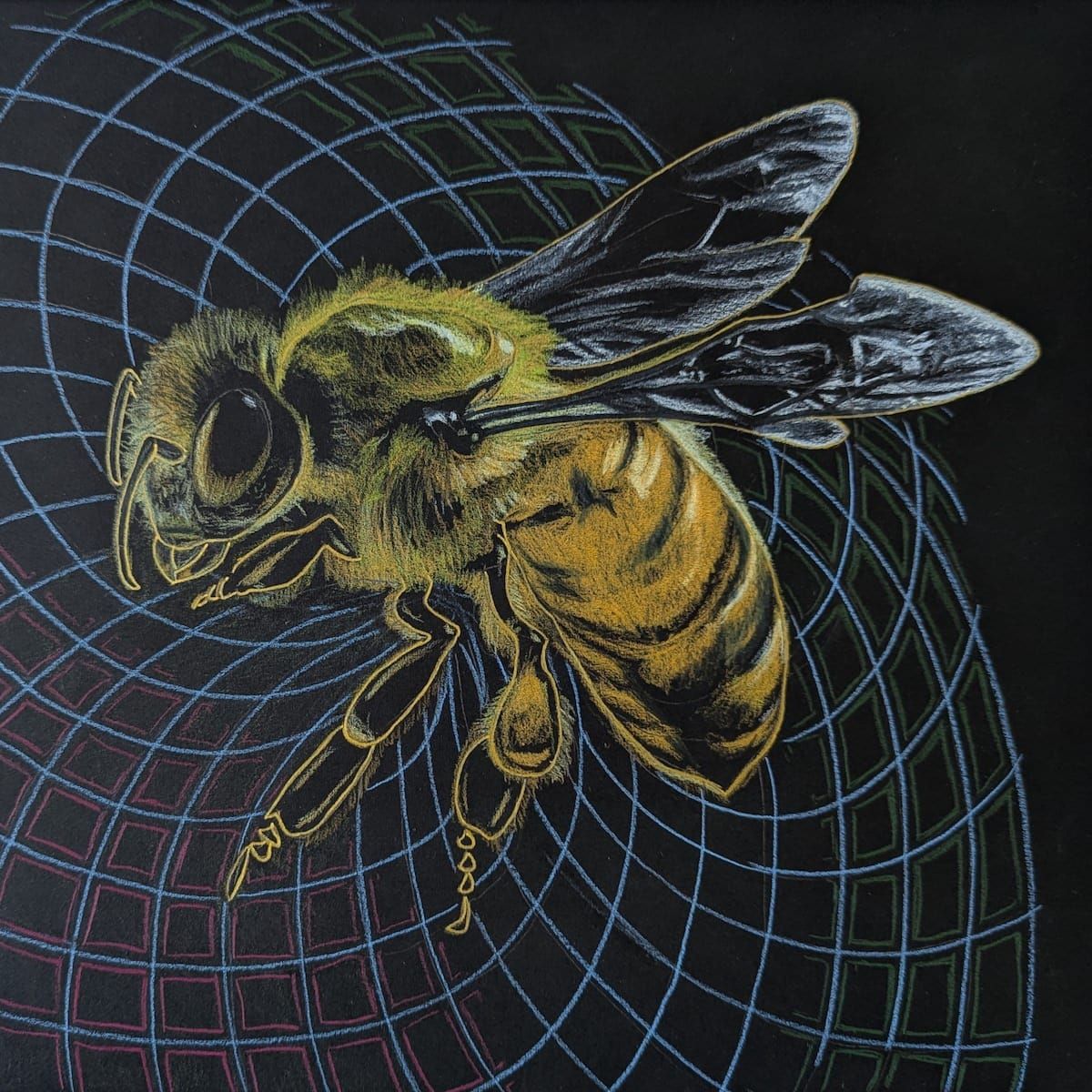
Bees, in this regard, provide a powerful example. In seeking nourishment, they pollinate plants, facilitating a beneficial cycle without which the earth’s ecosystems would falter. While each bee produces only a tiny amount of honey, together they produce enough to sustain the hive through the winter.
Of course, in the modern era, bee colonies sometimes come under strain. Recently I read an article about the business of transporting bee hives to pollinate commercial fields and orchards. A significant portion of the hives moved this way perish in the process, succumbing to temperature fluctuations or other kinds of stress. Talk about exploiting your workers!
If too many beehives suffer collapse, those same companies themselves can risk failure. In recent years high rates of colony collapse led many to fear that our whole agricultural system could break down if the trend continued. As it turned out, the bees have mostly recovered, but we should take the hint: If we want to thrive, we’ve got to take care of the little things.
Samyag ajiva is usually translated as Right Livelihood, and as with many of the Eight Limbs, this is traditionally framed in terms of restraint. Bhikku Bodhi writes, “The Buddha mentions five specific kinds of livelihood which bring harm to others and are therefore to be avoided: dealing in weapons, in living beings (including raising animals for slaughter as well as slave trade and prostitution), in meat production and butchery, in poisons, and in intoxicants. He further names several dishonest means of gaining wealth which fall under wrong livelihood: practising deceit, treachery, soothsaying, trickery, and usury.”
The ethics here are easy to see. If we make our living deceiving, abusing or exploiting others, then obviously we’re likely to face consequences. Certainly there can be gray areas, but if we often find ourselves treading in murky waters, maybe it’s time to seek other work.
We’d also be wise to avoid professions that actively involve violence, whether against humans or animals. This is to avoid harm to others, but it’s also to avoid harm to ourselves. Violence lingers in our bodies and minds, sends karmic echoes racing, creates intense anxiety and leaves our nervous systems jangling.
Considered affirmatively, to practice samyag ajiva means to nourish ourselves and others. You might then call it True Sustenance or True Nourishment.
Having spent a good portion of my own professional life in either restaurants or Dharma centers, it seems natural to me to consider sustenance and livelihood as one subject. Food is work, work is food. For millennia this was obvious to essentially all of humanity: we work to eat.
In Zen, the position of head cook, or tenzo, is spoken of as an office suited for someone of deep understanding. Maybe it isn’t clear why. In our modern culture, we tend to regard food as a mere commodity, and those who prepare it as hired laborers. We may even mock food-service jobs as just “flipping burgers.”
But it’s the world that’s flipped upside down. Fast food chains demean everyone involved, causing incredible harm. Their high-fat, high-sodium, high-sugar products cause heart disease and diabetes in their customers. Their workers are treated as replaceable cogs in a food production machine with poverty wages to match. And the low-grade meat they serve, heavily reliant on factory farms and feed lots, is unbelievably cruel, wasteful and environmentally destructive.
We should understand that after breathing, food and drink present our most basic point of connection with the living world. We are what we eat; and if we really understand that old saw, we’ll see that we are the whole living world and all its constituent parts: plants and animals, farmers and fields, salt and tides, sun and leaves. Recognizing this, we give thanks, lifting our bowls to the web of beings whose efforts give us life itself.
True cooks understand this. Food isn’t a number of calories and a list of nutrients, like you find on the back of a plastic package. It’s the love we receive from our mother, which settles in our bellies and leaves us warm and satisfied.
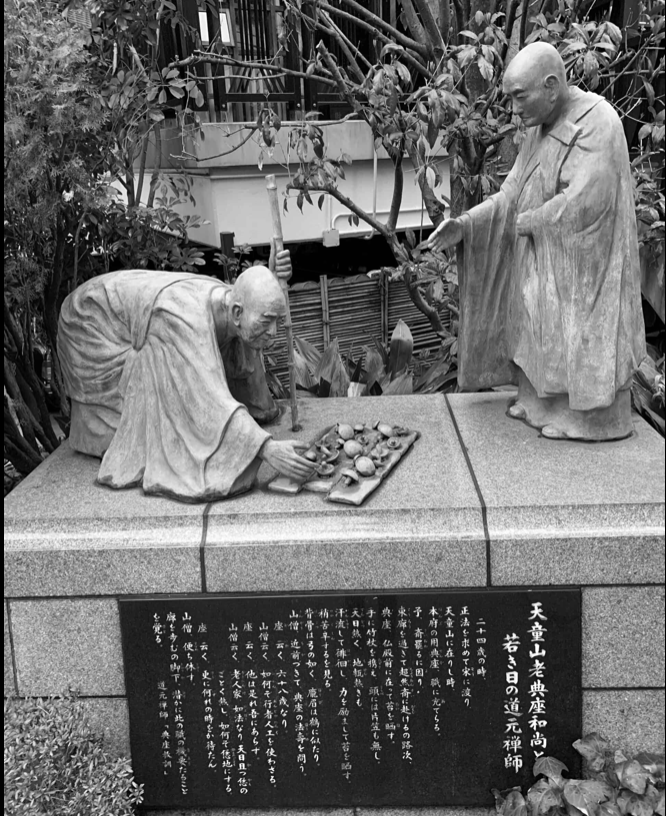
Cooking is a sacred endeavor of the highest nature – like dancing, at once an art form, ritual and celebration. It’s also the most prosaic activity in the world. To balance these aspects requires a mature practice, and the position of tenzo was traditionally given to monks of high realization. Consider this story from Dogen's Instructions for the Cook:
When this mountain monk was at Tiantong Monastery, the position was held by cook Yong. ... Once, after the midday meal, I was passing through the east corridor on my way to the Chaoran room, when I saw the cook in front of the buddha hall airing mushrooms. He carried a bamboo staff in his hand, but had no hat on his head. The sun was hot, the ground tiles were hot, and sweat streamed over him as he worked diligently to dry the mushrooms. He was suffering a bit. With his backbone bent like a bow and his shaggy eyebrows, he resembled a crane.
I approached and asked the cook his dharma age. He said, "Sixty-eight years." I said, "Why do you not employ postulants or laborers?" He said, "They are not me." I said, "Venerable sir, your attitude is indeed proper, but the sun is so hot; why are you doing this [now]?" The cook said, "What time should I wait for?”
Cook Yong really understood his profession. Centuries later we’re still enjoying his mushroom feast. Like Jesus, he offered himself up body and soul.
In Buddhist practice, we’re constantly encouraged to give. The practice of giving represents the highest spiritual ideal, and dana, generosity or giving, is considered the root of all virtue. Every time we sit down on the cushion and let go of thoughts, we give ourselves away. We do the same with wholehearted work, whether it’s doing the dishes, answering emails or caring for the sick. Enter into serving without reservation, and we may even experience the “dropping off body and mind” spoken of with such reverence by Dogen – forgetting ourselves in the midst of activity.
On the other hand, if we are to care for all beings, we also need to care for ourselves. This is obviously true in a capitalist system that may require us to draw hard boundaries with our employers. But it’s also true even when we’re doing vital work for organizations with worthwhile missions.
Burnout is real, and most of us at some point will experience it. Whether we’re overwhelmed by the genuine needs of others, or have difficulty drawing boundaries with our boss, or are driven by our own overweening expectations for ourselves, we can find ourselves drained of every drop of energy – including the empathy that motivated us in the first place. Sooner or later, exhaustion will bring us to a place where we just don’t care anymore.
As with the bee hives and the problem of colony collapse, the point is sustainability. To practice samyag ajiva skillfully means bringing giving and receiving into balance, to match our highest aspirations with our deepest needs.
Of all the Eight Limbs, I’ve personally found this one the most difficult to practice. My own career path has been helter-skelter. From an early age I’ve wanted to work as a writer and artist, but the path to get there was never obvious.
I grew up in a little logging town far north in British Columbia, Canada. My mother cared for us at home and my stepdad worked in the sawmill. When my older brother turned sixteen, he went to work in the sawmill too. When my younger brother got old enough, he did the same.
Me? I got out. At fifteen I went to live with my biological father in the U.S. He worked as a traveling nurse and we moved around a lot. When it came time for me to graduate, we were living in Casper, Wyoming. When his contract ended, he moved on to Alaska; being mightily attached to my girlfriend, I stayed, and got a job washing dishes at a truly terrible chicken-wing place across town.
They say your first job often dictates the course of your career, and so it proved with me. Having worked in food service, I was now qualified for one thing: food service. I worked at Taco Bell (twice), Arby’s and Mini Mart. I tried to do other things. I did phone sales, did temp work at a thrift store and at a bunch of factories. I once spent two weeks on an assembly line at a plastics factory making smiley-face air fresheners, dropping scented cakes of soap into the spheres or clicking them together. I was surprised at how fast the line moved – a manic pace.
Eventually I did go to college. Afterward I moved to Seattle with my girlfriend (you may notice a pattern here), which in hindsight was a mistake. I knew no one in Seattle and a job was not forthcoming. I sent dozens of applications into the void. My money dwindled to nothing. At one point I received notification of overdraft fees on my account, and learned that someone in North Carolina had used my credit card number to withdraw four hundred dollars from an ATM – as it happened, my last four hundred dollars. I was flat broke.
The bank eventually restored my money (minus some overdraft fees I never did get back). Meanwhile I found out what the very cheapest food is at the grocery store: beans, rice, potatoes, onions and cabbage (it was a gassy time). Fortunately by then I had a job at a local pizzeria and could eat as much pizza as I could stomach.
I ended up spending five and a half years at that pizzeria. It was a good company (shoutout Pagliacci) and after a few years I had a nine-to-five schedule. But often I felt despair. I was in my mid-thirties. I was smart, I was able-bodied, I had a bachelor's degree. But the opportunities for more fulfilling work just never seemed to materialize.
Despair has often been the mood I most associate with work. It seems like some people settle early on a direct path to a fulfilling job, becoming doctors and such. If that’s you, congratulations. But it hasn’t been my experience. Exploitative companies, domineering supervisors, dirty, dangerous conditions, taxing commutes and exhausting hours are the everyday reality of billions.
Sometimes when I read commentaries on work, I get a strange feeling of disconnection, as though work, the kind of work I’m talking about here, is something the author’s only heard about. Maybe it’s just that books are often written by bookish sorts – people with graduate degrees and office jobs.
So let’s be real: Jobs can be hell, and as a basic starting point for discussion of Right Livelihood we should recognize that our whole global economic order is built on the extraction of labor from the poor for the benefit of the rich and ultra-rich. Compulsory labor is at the heart of nation states and always has been, right down to the ancient agricultural states, which relied on slaves captured in war to work the fields. Empire is premised on the exploitation of laborers and colonialism is fundamentally built on slavery. This is just as true today as it’s ever been.
If we want to practice Right Livelihood, we need to start there, by building cooperative institutions that reflect our values of generosity and goodwill. Failing this, we’ll all continue to be trapped in systems that chew up everyone and everything, up to and including the natural ecosystems every human being relies on.
This isn’t the work of a day or a year. It moves in generations, in lifetimes, in centuries. It may also be intensely difficult individually, when taking a suboptimal job is a necessity rather than an easy choice. Sometimes all we can do is lean in the direction of goodness.
Maybe you know what it is to spend years in a job you hate, or just don’t particularly care about. You may feel stuck, like the figure in an old Zen koan, hanging from a tree by your teeth, flailing around, trying to find any branch to hold or any firm ground to stand on.
This kind of despair has a way of manifesting in our bodies: back aches, sore wrists, migraines and stomach pains. We feel our lives slipping from our grasp, our years vanishing behind us, our bodies consumed by demands we never asked for.
But I have to ask: Are you as stuck as you think? I’ve also known plenty of people who seemed to hold onto jobs they disliked way longer than necessary. Usually it’s out of a fear of insecurity, the vision of ourselves ending old, infirm, poor and alone. So we develop an intense focus on building a comfortable retirement fund to protect us.
Of course we should have a realistic plan for the years ahead. On the other hand, it’s crazy to exchange the healthiest years of your life for a retirement that may never even come. You might consider that Steve Jobs, one of the wealthiest and most powerful men on earth, died of pancreatic cancer at age 56. I’m not saying he didn’t live a full life, but I’m pretty sure he didn’t expect to die in his mid-fifties. You don’t know what’s going to happen, so don’t throw away the present always living for tomorrow.
Speaking of the present, I love that in modern slang, “to cook” means to create, or to combine various elements in creative ways. It’s a kind of alchemy, turning dross into gold. It’s organic, it’s free-wheeling, it arises from the body. Whether you’re an artist, musician, teacher, engineer: anybody can cook. You can cook.
Maybe you say, come on, man. I’m stocking shelves at Walmart here. How can I cook?
Well, first, there’s the ordinary sort of problem solving. There may well be ways to improve efficiency, to maximize your movement. Just watch a great cook, watch how they move. They’re incredibly fast, incredibly efficient. You'll see that they have a kind of real grace. Whatever you’re doing, you can use it as an opportunity to practice that same kind of mindfulness in movement.
Second, there’s the social aspect. Most often, the real work at any given job is relational. How are you relating to your coworkers, to your supervisors, to your customers? Are you connecting with them? If your workplace really is exploitative, is there any way to move the needle toward a more just and equitable arrangement? Is there a space for you to help organize?
Third, and most important, is our practice of inquiry. Dogen said, “In general, the job of the cook is an all-consuming pursuit of the way.” To cook is to inquire into the nature of food, the nature of whatever is at hand. While recipes can be useful starting points, chefs are constantly tasting their dishes. They need to know firsthand the level of spiciness, the texture of a carrot, and consider what else they might add, what new direction they might take. If you really place all your attention on the task at hand, no matter what it is, if you allow your natural curiosity to open onto your immediate sensory experience of the world, you'll find that you enter a limitless field of possibility.
Understand this, you’ll see that there are no obstacles, no insurmountable walls, only gates. Even an absence sustains us; even what’s missing fills us. Always curious, always flowing with circumstances, we discover a boundless wellspring of strength and creativity.
Even our despair is transformed. What appeared difficult or impossible, once accomplished, becomes a source of deep contentment. It’s exactly like the experience of planning to make a dish only to find that we’re missing an ingredient; and so we take a different direction, use some other spice, and find that the result is richer and more vibrant than anything we could have planned.
If this is true individually, it’s a thousand times more true collectively. The problems we face really are daunting. But the pursuit of their solutions can become a source of the most profound understanding and compassion – and having succeeded, the whole earth will exhale with deep relief, a kind of satisfaction and joy we can now barely imagine.
Even bees cook, in their own way. The nectar forager bees collect from flowers is mostly water. Once back at the hive, they transfer the nectar to hive bees, who work to turn it into honey. This first involves a process of continuous regurgitation and digestion, including repeatedly blowing the honey into bubbles between their mandibles. They place the resulting substance into uncapped honeycombs, but its water content is still too high for proper preservation. So the final step is to literally cook the honey with their own body heat (the hive in these areas is around 95 degrees Fahrenheit), while regulating the temperature and expelling the evaporated moisture from the hive by beating their wings in coordination.
It’s amazing, really. Working together, bees really do achieve a kind of alchemy: turning nectar into gold, liquid gold.
Consider Dogen one last time: “The Dharma Wheel turns from the beginning. There is neither surplus nor lack. The whole universe is moistened with nectar, and the truth is ready to harvest.”
So call up your crew and roll up your sleeves. You’ve got everything you need. It’s time to cook.

Member discussion: