
🎧 Listen to this episode on Earth Witness | Apple Podcasts | Spotify
There’s a story about Zen Master Ichu, who was known for his beautiful calligraphy. A student asked him:
“Please write for me something of great wisdom.”
Master Ichu picked up his brush and wrote one word: “Attention.”
The student said, “Is that all?”
The master wrote, “Attention. Attention.”
The student became irritable. “That doesn’t seem profound or subtle to me.”
In response, Master Ichu wrote simply, “Attention. Attention. Attention.”
In frustration, the student demanded, “What does this word ‘attention’ mean?”
Master Ichu replied, “Attention means attention.”
- Charlotte Joko Beck, Nothing Special, p. 168
Never in history has there been such competition for our attention. It is, in a sense, the ultimate resource, because without it we are truly adrift, compelled by impulses operating below the horizon of consciousness. Living consciously begins by paying attention - and actually, it begins by paying attention to the act of paying attention, to understanding where and how and why we direct our gaze. This is the practice of samyag drishti, True Seeing, the first limb of the Buddha’s Noble Eightfold Path, and the second essay in this series titled “Turning the Eight-Limbed Wheel: The Somatic Practice of Buddha Dharma.” Listen closely; look closely.
In the book Four Arguments for the Elimination of Television, published way back in 1978, author Jerry Mander pointed out that in any room, a screen is always the brightest and fastest moving object, drawing your eyes involuntarily. Probably you’ve experienced this at any sports bar. The bar may be filled with people and friends, but your eyes are drawn magnetically to the screen whether you’re interested in sports or not.
Today there are more screens in our lives than ever, especially these troublesome little devices we insist on keeping in our pockets at all times, constantly demanding our attention. The companies selling the phones and managing the platforms understand that at a basic level, attention is the ultimate resource—and it is finite. To maximize profits, companies must maximize time spent on their platforms, using a host of cognitive levers to compel our attention and fuel an addictive cycle of craving and reward. As a basic starting point for the development of insight, we have to understand the way this cycle feeds an attention deficit.
Most often our conscious attention acts as a kind of spotlight, illuminating whatever is within our circle of attention and leaving everything else in the darkness. When our attention is occupied, as it is when we use a phone, we tend to ignore other sensory input. Thus compulsive phone use comes at the expense of both our ability to focus for extended periods and of the immediate experience of our senses--which is to say, the sights, sounds, smells, tastes and sensations that comprise our lived experience.
Turning to our central topic, the first limb of the Noble Eightfold Path in Sanskrit is samyag drishti (sammā diṭṭhi in Pali). I was first introduced to this limb as “Right Understanding,” a translation I now find inadequate. Drishti is derived from a Sanskrit verb meaning “to see,” but “understanding” completely elides the concept of sight, equating the term entirely with mental comprehension. This does an enormous disservice to those who would practice it, considering the complexities and importance of our literal gaze.
It must be admitted, however, that this interpretation is more or less in line with traditional Theravadan exegesis, which directs students to correct their beliefs and conceptual frameworks as a precondition for practice. After all, if we hold delusive beliefs at the outset, they will lead us to all kinds of harmful actions that can prevent us from practicing. Correcting our views in this vein means understanding two core teachings:
The first is the law of karma, cause and effect, which states simply that “wholesome actions yield favourable results, unwholesome actions yield unfavourable results” (to quote Bhikku Bodhi in his book The Noble Eightfold Path: Way to the End of Suffering). We have to accept that our actions have consequences, for ourselves and others. To understand which actions are wholesome or unwholesome, we can look to the Buddha’s Five Precepts: not to kill, not to lie, not to steal, not to abuse sex and not to abuse intoxicants. These guidelines, considered expressions of the enlightened mind, are grounded in ahimsa, non-harming. Expressed positively, they mean to cherish all life, speak the truth, respect the things of others, and to keep our relationships simple and mind clear.
The second teaching is the Four Noble Truths: the understanding of dukkha (misalignment or disharmony, discussed in the first essay of this series); of tṛṣṇā (Pali tanha), thirst or craving, the persistent desire that things be other than they are, as the cause (samudaya) of dukkha; of nirodha, the cessation or stopping of thirst, as the way to freedom from disharmony; and finally, of Arya Ashtanga Marga, the Noble Eightfold Path, as the specific and practical recommendation for how to achieve spiritual liberation.
This is a cursory summary of the traditional explication of samyag drishti, but as my purpose here is to highlight aspects little explored elsewhere, I’ll leave it there. If you would like an unornamented commentary in the traditional Theravada vein, I refer you to Bhikku Bodhi’s book.
Now, I don’t mean to suggest that conceptual frameworks have no value. Cultivating our knowledge of Buddhist doctrine can yield deep insights into ourselves, the origin of our unease and the nature of things as they truly are. At the same time, it’s perfectly possible to become a human archive of the sutras while engaging in every kind of bad behavior. We need only consider how often supposedly enlightened teachers have been caught in abusive behavior to see the limits of conceptual understanding. Ultimately, if we are to practice samyag drishti deeply, we must manifest it concretely in our lives, bodies and relationships.
And when we investigate samyag drishti through this somatic lens, we find a verdant landscape unfolding before us. In yoga, drishti is understood as the directed gaze. When practicing asana (physical poses), we direct our gaze at a certain point: between the eyes, toward the navel, and so on. Thus there is a prescriptive focus: it’s important not only that our vision be clear and unobstructed, but that we direct our gaze to the appropriate point.
In yoga as in Buddhism, drishti also means directing our inward gaze, our spotlight, to the intention of the pose. For instance, when standing in vrikshasana, tree pose, we look to a fixed point directly in front of us. Functionally, this helps maintain our balance. Inwardly, we look to the qualities of the pose: the sole of our foot reaching down into the earth like roots, our long straight trunk, our spreading arms and fingers like branches and leaves. Holding the image of a tree in our mind, we develop balance and stability, growth and resilience.
In Zen meditation (or zazen), we cultivate one of the ancient meditation postures, seated firmly on a cushion, back straight, hands at rest in our laps. In zazen we keep our eyes open, gazing steadily at the ground a meter or two in front of us. Internally, we bring our attention to our practice—counting the breath, just listening, investigating the point of a koan—returning to this single point and single breath whenever our attention wanders.
More, to keep a steady gaze in zazen means continually returning to our deepest questions and highest aspirations. Why are we here? What is all this? How can we ease our suffering and the suffering of others?
Look also to the qualities of this posture: back upright, arms and legs settled, heart open, eyes and ears open. This posture is unique, at once completely still yet profoundly active, at rest yet inquisitive, contained yet open. When we sit this way every day, it begins to inform our consciousness. We begin to understand that it is a posture not just of the body, but of the heart-mind, our unceasing Buddha-mind.
Along similar lines, in Buddhist retreats and sesshin (Zen retreats), we are directed to keep our gaze lowered rather than meeting each other’s eyes. Eye contact, as we all know, is very powerful, because it places our attention squarely on the mind and consciousness of another. By avoiding casual eye contact for the duration of the retreat, we protect our inward focus.
Outside of retreats, everyday social interactions involve a subtle dance of the eyes. When meeting someone for the first time, we offer a direct gaze, extended a second or two longer than usual to indicate our respect and appreciation of the person in front of us. During ordinary conversation, we gaze more or less steadily, but if we stare too intently it may make our conversational partner uncomfortable, so we break eye contact regularly, looking toward the floor or out the window. Insufficient eye contact or prolonged staring are both considered markers of poor behavior or social maladjustment.
In the human realm as in the animal kingdom, staring can be interpreted as a challenge. Most Buddha figures have soft or downcast eyes, reflecting their inward contemplation and gentle nature; some, however, like Bodhidharma or Fudo Myo’o, the “Immovable Wisdom King,” glare with bugging eyes, demanding that we meet our delusions head on, reigning in our destructive drives and ceasing our self-deceptions. In this kind of effort the gaze is all important, because without it we cannot see where we err.
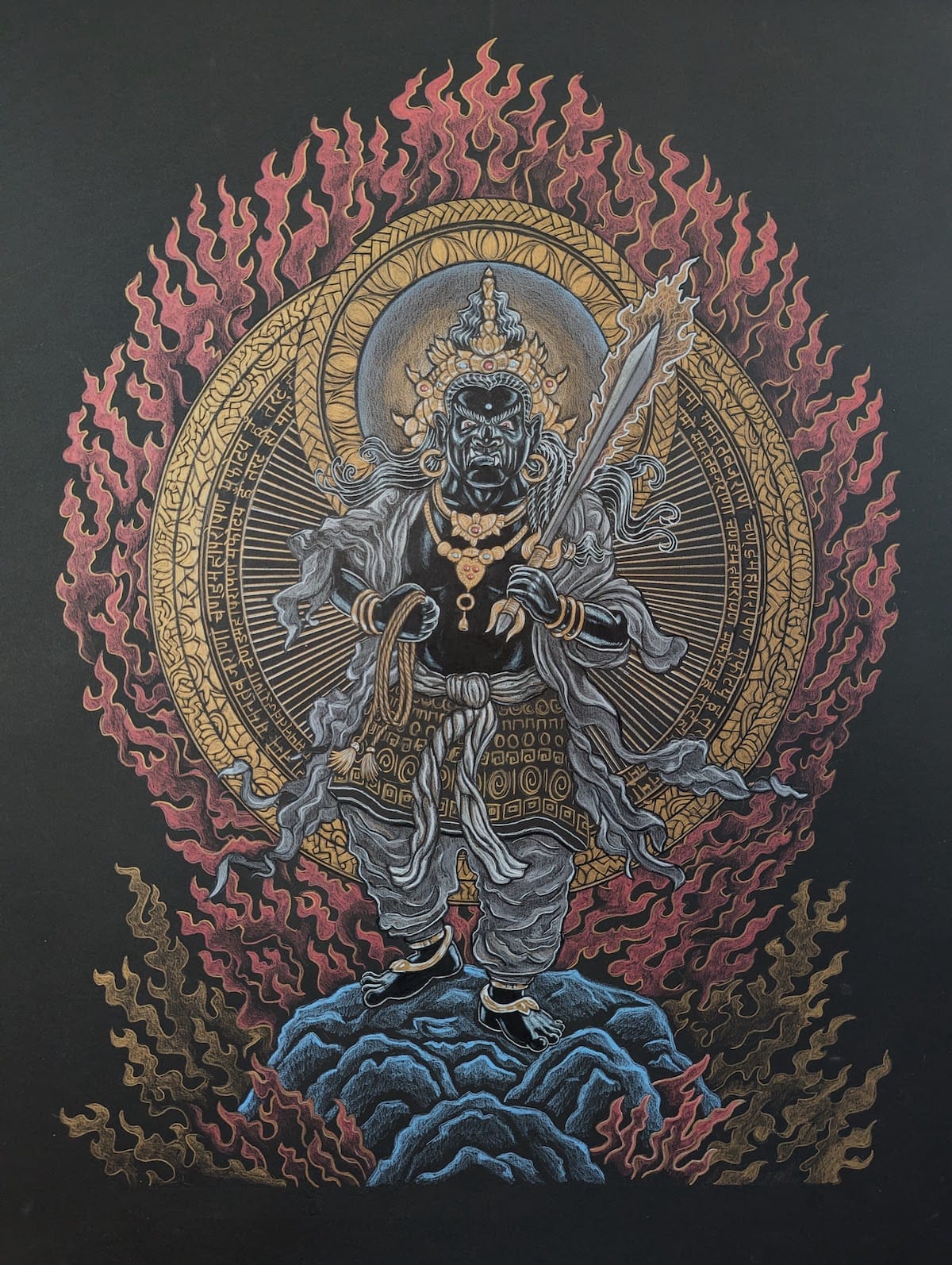
Every artist recognizes this truth. To see is to understand; delusion depends on a kind of blindness. By engaging directly with our deepest questions and manifesting our answers concretely, we gain enormous insights into ourselves and the world.
Buddhists practicing in the Vajrayana tradition are famous for their visualization practices, constructing baroque mandalas and vivid bodhisattvas with dozens and hundreds of iconographic details without which the whole is incomplete. Vajrayana artists train for decades to master the proportions, colors and symbolism of various archetypes. An outsider might wonder at such slavish devotion to tradition, but both artists and everyday students are not merely mastering the details of ideal form; they are internalizing the qualities they envision.
How often have we lamented the gap between what we imagine and what we possess? We look around a comfortable house, full of luxuries unimaginable to our ancestors, and see only the larger, more expensive, more elaborate home we wish we owned. Likewise, we may look at ourselves in the mirror and fantasize about how our abs might look with six month’s exercise; and so on in our careers, relationships, our very feelings of self-worth.
But we should understand, as true artists do, that at the deepest level perception and reality are not two. To see fully is to make manifest. Conversely, if our aspirations have not yet come to fruition, it is precisely because our vision remains partial.
If you doubt this, just consider how many breakthroughs—scientific, artistic, personal—are essentially perceptual in nature. After years of study, effort and experimentation, we may feel that we are at a loss, bashing our heads against a wall. Then, one day, something shifts. Most anything can trigger it: a conversation, a walk, a shower, a dream. We see the solution, and with that insight all the problems we previously thought insuperable vanish like fog in the sunlight.
Of course, we can’t dismiss the preparation beforehand. Revelation may well come in a flash, or seem to, because there is always a definite moment in which we understand and know that we understand: the moment of epiphany. But it is actually inseparable from the years of labor and slow, steady investigation that led us to that moment. Einstein could never have developed the theory of relativity without years of training in physics and mathematics; Watson could never have dreamed of two intertwining serpents had he not already devoted his life to finding the structure of DNA.
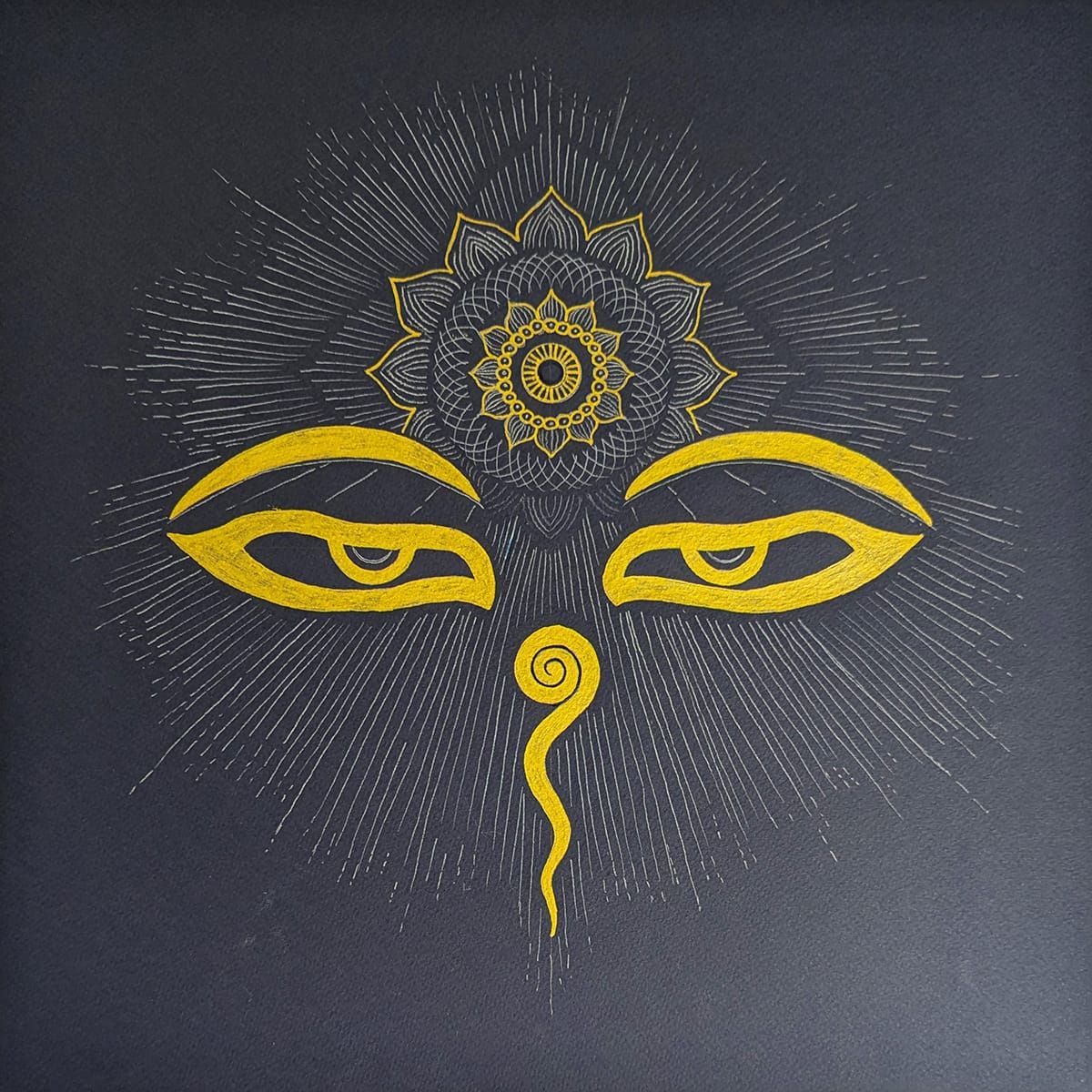
The same is naturally true of an even more fundamental insight, that is, the perception of the true nature of being. This is the “True Dharma Eye” that is undeceived by all falsehoods, perceiving reality at its root. The universe in all its shifting forms arises and passes away in majesty and splendor: aspen leaves flickering in the wind, a dog running after a ball, your own wrinkled face in the mirror. The eye is not deceived; it does not mistake the pointing finger for the moon; it rests in unconditioned being like a lotus floating effortlessly upon a still dark lake. This is, as Yung-chia wrote, “the complete realization of mind, the complete cutting off of delusion, the power of wise vision penetrating directly to the unborn.”
True students of Buddhism practice for decades to develop this Eye and enjoy firsthand the awakening described by the ancients, but in fact it is not uncommon for even completely untrained individuals to experience moments of non-duality in the course of their everyday lives. Perhaps in childhood we experience a day of rain, the sound of the drops seeming to extend forever. It can be triggered by a profound or traumatic event, a birth, a death. Maybe we are running or skiing; but whatever the circumstances, we find ourselves suddenly vast and boundless, possessed of an understanding that can never be expressed in words.
However, if we have no framework for that experience, it may well pass through us and leave little trace of its passage, becoming merely one more memory to be buried under successive layers of experience, like a beautiful apple left to rot on the ground. To really benefit from these moments of complete absorption, of samadhi, we have to prepare ourselves, pulling the weeds and amending the soil for the seed to take root.
The Buddha himself had just such an experience. It’s said that in his search for truth he joined a group of sramana, religious renunciants, and undertook the most severe austerities, living on a single sesame seed a day. Finally, lying near death in the forest, he recalled a certain festival day in his youth, when sitting comfortably with his back against a tree, he had an experience of deep unity with the harvest scene in front of him. His senses seemed to expand, his body to grow large. Confusion and conflicts fell away, and he was left with the cries of the farmers, the buzz of the flies, the warmth of the sun on his face.
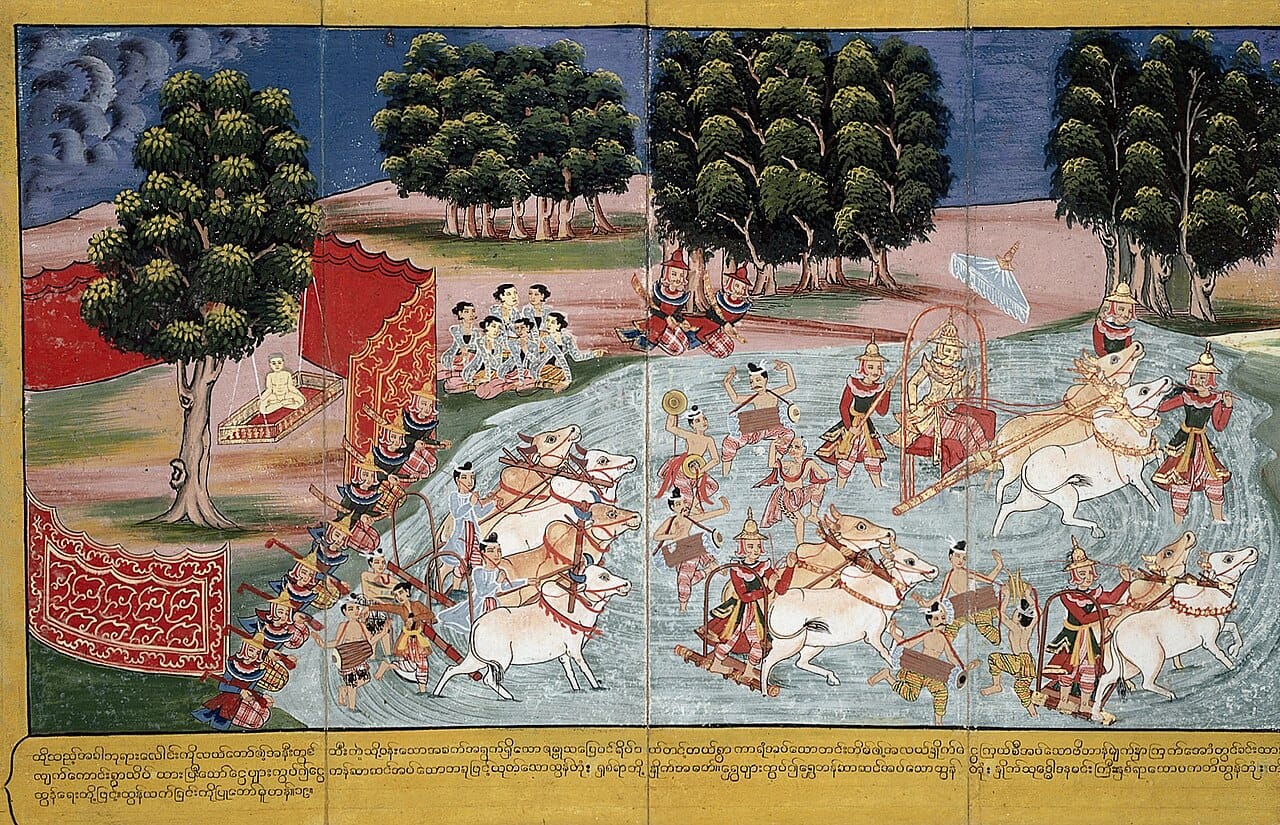
Yet note that it was only years later, after long and arduous inner searching, that he was able to recognize this experience as vitally important. Inspired by this memory, he rose, took sustenance, and proceeded to meditate under the bodhi tree and find the Middle Way.
In this Shakyamuni was guided by his deepest intuition, the only guide available to him at the time. We, on the other hand, have the enormous advantage of the Buddha’s own experiences and teaching, along with the millenia of Dharma teaching that followed. We need not grope blindly in the dark. We only have to open our eyes.


Member discussion: