
🎧 Listen to this episode on Earth Witness | Apple Podcasts | Spotify
Right now you’re hearing my voice. If you’re listening to the podcast, you’re hearing the sounds emitted by my larynx and mouth, the tone and timbre, inhalations and exhalations, pops and clicks (hopefully not too many pops and clicks). To be more precise, you’re hearing a digital rendering of those sound vibrations, as recorded by a microphone, edited on a computer, transmitted to your device, and then emitted by the diaphragms in your speakers. While audiophiles may protest this digital deconstruction and reconstruction, this voice nonetheless begins and ends as a vibration.
Maybe, though, you’re reading this essay, your eyes scanning left to right and back again on the screen. Even then, you’re hearing my voice: my authorial voice, that is, my words communicating a particular pattern of meaning; and this pattern, what one might again call a vibration of meaning, passes from mind to mind, echoing around the world.
But be careful. Words can instruct and illuminate, but they can also deceive, limit and enclose. Consider the words of Daio Kokushi: “Wishing to entice the blind, the Buddha has playfully let words escape his golden mouth. Heaven and earth are ever since filled with entangling briars.” (qtd. in D.T. Suzuki, “On Zen,” in Manual of Zen Buddhism)
Today we take up samyag vāc, True Voice, the third limb of the Noble Eightfold Path, often translated as Right Speech. With this, we leap into the briars – and hopefully, back out again.
As humans, speech is perhaps our foremost means of interacting with the world, in some ways taking precedence even over physical action, since speech is the primary mechanism for social interaction. Our words can comfort or antagonize, heal or harm, start wars and foster peace. Recorded in writing, words comprise a great portion of the corpus of human knowledge and culture, which we pass down generation to generation. The teaching of samyag vāc itself originates with Shakyamuni Buddha twenty-five hundred years ago, flowing like an ancient river down through the ages.
In speaking, we manifest our thoughts in the world. Thus words have a karmic effect far greater than thought, and this comes with a concomitant level of responsibility. I’m sure we’ve all known individuals who seemed to blurt out every thought as soon as it arose, like small children do. There is a certain pleasure in unfiltered expression. But as adults, we need to cultivate a gap between the thought and the expression of the thought; because after all, we may have all kinds of thoughts that would be terribly harmful if spoken aloud, and indeed we’ve all said things we regret.
The Buddha taught that samyag vāc meant four kinds of restraint: not to speak falsely, not to speak ill of others, not to speak harshly, and not to speak idly. Expressed positively this means to speak truly, amicably, kindly, and purposefully.
Of the Ten Grave Precepts that form the ethical guidelines of Mahayana Buddhism, four are concerned with speech: not to speak falsely, not to speak of the faults of others, not to praise oneself while disparaging others, and not to defame the Three Treasures of Buddha, Dharma and Sangha. If we have doubts about any one of these, it’s better to remain silent.
Well, you say, that’s a lot to remember. If I’m constantly trying to pass every sentence through a gauntlet of gates and restraints, I’m never going to open my mouth. Fair enough! Nor do accomplished speakers ruminate before every word. To the contrary, Zen masters are famous for speaking without hesitation, like a flash of lightning or the swift stroke of a sword. Not a single thought precedes the response. It’s like the way a tree makes a sound when struck with a rock: Tok! This responsiveness is written in bones, muscles and skin. It shines effortlessly and naturally as light from the sun. Phrases and words flow tracelessly, sparks flying to ignite sudden illumination in the hearer. This is called the “turning word” of Zen.
So far, we’ve been discussing samyag vāc considered as “Right Speech,” but words alone are not the whole story. Vāc is etymologically related to “vox” and “voice.” Words can have a way of sounding like something apart from us, especially when written down, something we see on a page or a screen. Not so with voice. Voice is immediate and intimate, the organic expression of our singular body-mind acting in the present.
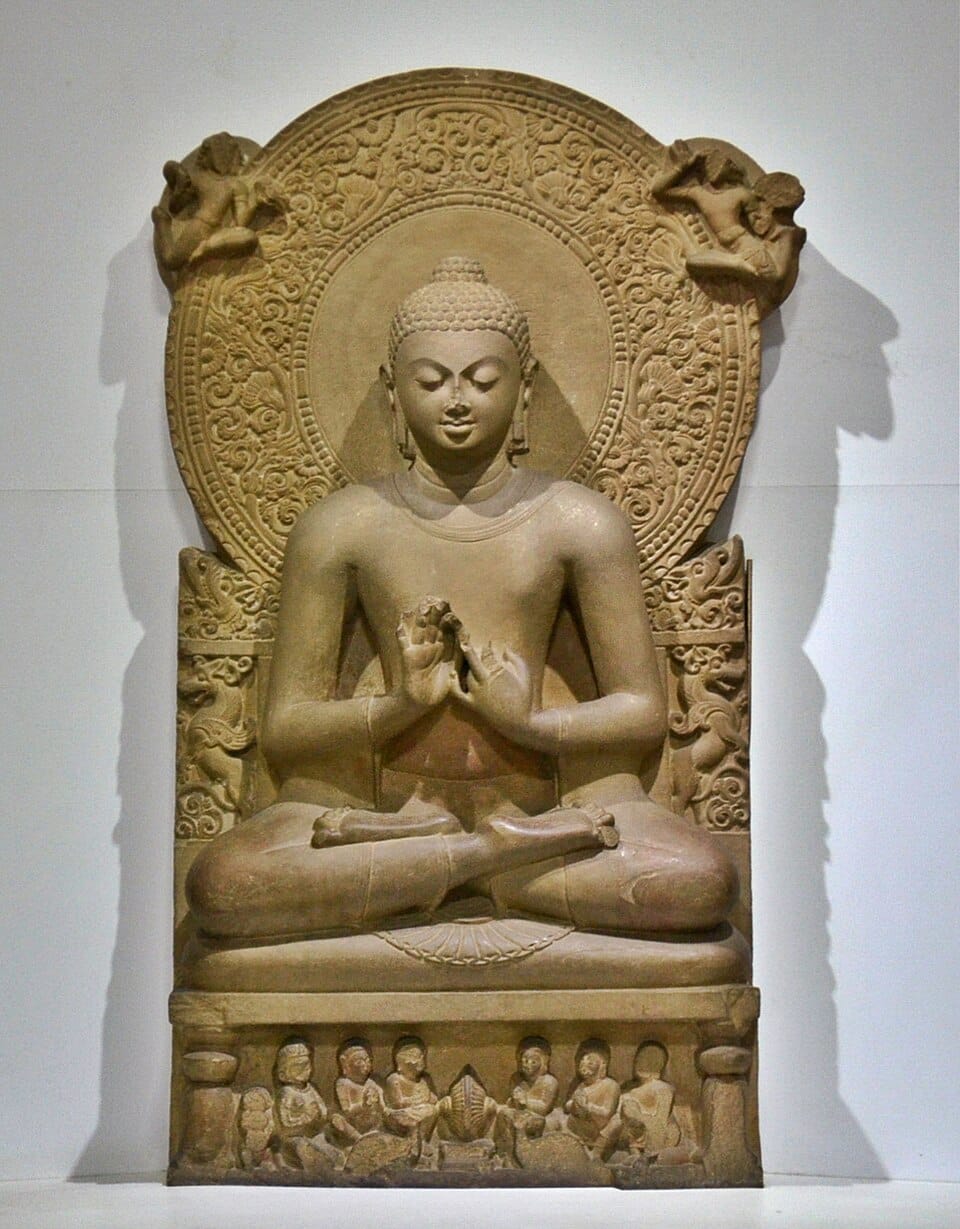
It’s worth pointing out here that Buddhism originated as an oral tradition. The Buddha taught primarily by speaking, not writing, and for centuries the Dharma was transmitted orally, passed on by constant vocal repetition and memorization, from monk to monk, generation to generation. We’ll take up the practice of True Recollection later in this series, but for now just consider that for the Buddha and his immediate followers, voice was always embodied. While the written word has a way of appearing to stand separately from the writer, lending itself to all kinds of misuse and misinterpretation, in an oral tradition the voice is synonymous with living presence, and hearing a voice implies a direct spatial connection between the one speaking and the one hearing.
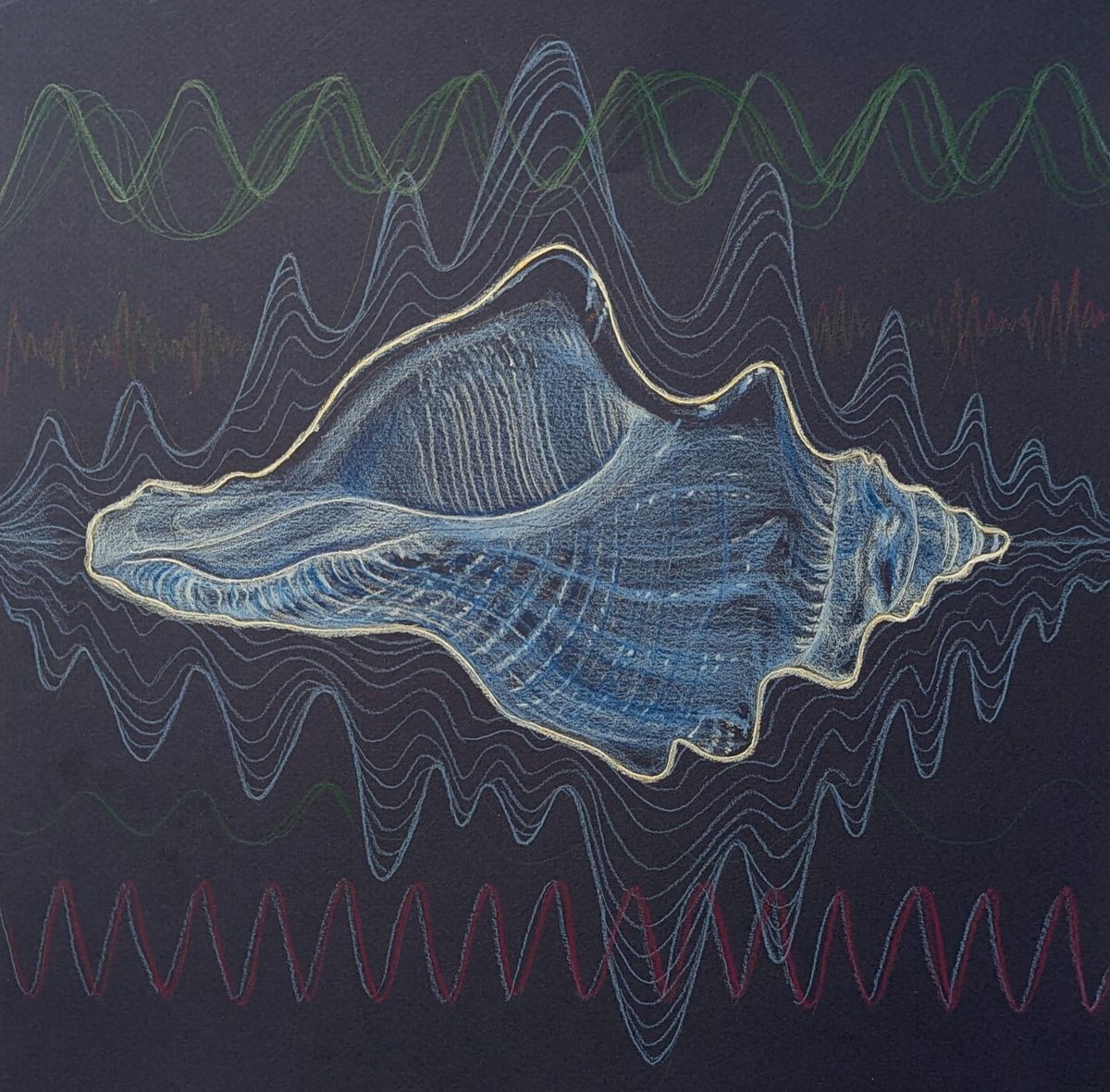
Considered karmically, the effect of our voice parallels the physical effects of sound, waves of vibration rippling outward, waves of causation rippling outward, bouncing off others and coming back to us, reverberating endlessly. We can call this the vibrational power of voice, which reflects the vibrational nature of the universe. We partake of it every moment on every level. Our senses detect vibrations of sound, light and heat, by which we perceive our surroundings, even as energy on other wavelengths, like radio waves, passes through us unnoticed. Our very cells, molecules and atoms vibrate together. If Right Speech asks us to accept responsibility for the karmic effects of our words, True Voice understands speech itself as one register among many, one tone in the great cosmic hum.
Beyond the conscious development of skillful speech, we can practice samyag vāc at this vibrational level, through singing, music, chanting and mantra practice. While silent seated meditation lies at the heart of most Buddhist practice, our practice sessions usually begin and end with resonant bells and chanting. By chanting wholeheartedly, with all our attention, we become one with the sound, one with highest truth expressed as sound.
In esoteric traditions, various syllables are invested with meaning and chanted by way of drawing the mind closer to those qualities. These include ancient Sanskrit arcanum such as om, ah and hum, as well as mantras like om mani padme hum. We can break down the significance of these mantras in various ways, but the point is to manifest the energy of the universe as sound, to manifest that sound as ourselves, ourselves as that sound: Ooooommm.
The meaning of the syllables is secondary--so secondary that some chants, like the Sho Sai Myo Kichijyo Dharani, “The Dharani of Good Fortune to Avert Calamity,” have lost any clear denotative significance. We chant for the sake of chanting.
In Zen, the closest we come to a mystic syllable is “Mu.” “Mu” is Zen Master Joshu’s famous answer to a monk asking, “Does a dog have Buddha nature or not?” “Mu.” Now, “mu” or “wu” in Chinese means “no” or “has not,” so on one level Joshu was simply saying, “No.” This answer, however, contradicted the Dharma teaching that all beings have Buddha nature; and elsewhere, in response to the very same question, Joshu answered, “Yes.” So, this contradiction is the crux of the koan.
In practicing Mu, however, the student drops any notion of “yes” or “no” and simply repeats this one syllable again and again, investing it with their whole life energy and inquiring spirit. As Wu-men says, “If you do not falter, you will, like a light flashed on in the dark, suddenly become bright.”
Voice transports us. Who among us has never been enraptured by a song? Some time ago I saw the band Elephant Revival, and the singer’s voice left me in awe.
Along similar lines, I’ve listened to the speeches of Martin Luther King Jr. again and again, and every time they send shivers down my spine. One could only call such performances inspired – literally, of the in-breath, and then the out-breath. Their effects ripple outward in waves of beneficence. Zen Master Dogen wrote, “Know that kind speech arises from kind heart, and kind heart from the seed of compassionate heart. Ponder the fact that kind speech is not just praising the merit of others; it has the power to turn the destiny of the nation.” And not just the nation: the whole living earth depends on the expression of kindness, and now more than ever.
Hakuin wrote of reaching enlightenment on reading the Lotus Sutra. For myself, my heart cracked opened on reading from the Tao Te Ching: “Those who think they know, do not know. Those who know that they do not know, know. For in this context, to know is not to know, and not to know is to know.” With these words my whole life to that point was laid bare, all my desperate attempts to present myself as strong, smart and competent revealed as nothing more than self-centered posturing. More, I saw the basic emptiness of my whole inner monologue, the way I had mistaken my subvocalized narrative as myself. Reading those words for the first time, I knew that I did not know, surrendering to the overwhelming fact of just being; and with that, the whole course of my life was altered.
Do you see? You are not your thoughts, and the world is always greater than your concepts about it. Alan Watts said, “If you’re always thinking, you have nothing to think about except thoughts; and so you’re never in touch with the real world.” Better to say that you’re a hot cup of tea, or the snow falling outside the window.
Do you hear? If you want to practice True Voice, first you have to practice True Silence. When the mind is still and the heart is in harmony, then our true voice rings out, like a great golden bell or the song of a blackbird, melodious, resonant and effortless. In hearing and speaking this way, we become Avalokiteshvara, the Hearer and Answerer of the Cries of the World.
Zen masters are sometimes known to give a yell, called katsu in Japanese. Teisho, the Zen talk delivered by a teacher, is translated as “presentation of the shout.” You might also call it the roar of the Dharma lion. There’s a story about the great Tang Dynasty master Yantou Quanhuo giving such a shout. Bandits attacked the monastery, and finding there was nothing to steal, one of them stabbed Yantou in the stomach. Dying, Yantou gave a shout that it’s said was heard ten miles away, the full expression of his life energy even as he received this mortal wound.
Today not many teachers engage in this kind of spiritual warriorship, and are more apt to offer their teaching quietly, even in a whisper. Maybe a quiet approach is best in an era of ceaseless noise. But don’t be deceived by a soft presentation, either. Just because you say something in a whisper doesn’t make it more true.
And I’ll repeat: When in doubt, it’s better to remain silent. In a world of noisy spectacle and endless clamor, silence is incredibly undervalued. It cuts off reactivity and offers us space for reflection, acceptance, and wholeness.
In this vein, one too many times I’ve heard well-meaning people repeat that “silence is complicity,” and it’s astonishing the harm this has caused. Of course there are times when we have to speak up against injustice, but this absolutely does not mean we’re morally obligated to log on to social media and shout our every political opinion at a crowd of complete strangers.
Far better to emulate the Buddha:
An outsider questioned the World-Honored One. “I do not ask for the spoken; I do not ask for the unspoken.” The World-Honored One just sat still.
The outsider thanked him, saying, “The World-Honored One with his great compassion and mercy has opened the clouds of my delusion and enabled me to enter the Way.” He then made bows and took his leave.
– The Gateless Barrier, trans. Robert Aitken (199).
The Buddha also refused to answer certain imponderable philosophical questions: Is the world eternal, or not? Is the universe finite or infinite? Does the mind exist separate from the body? Does consciousness persist after death?
Obviously the Buddha must have had thoughts on these subjects, but he refused to speak on them. Why? Because even aside from the knowability or unknowability of the answers, they wouldn't serve to alleviate dukkha or disharmony. They wouldn’t help.
And that’s the core here, the heart of the teaching, and the only question we genuinely need to ask before opening our mouths: Does this help?
Member discussion: