
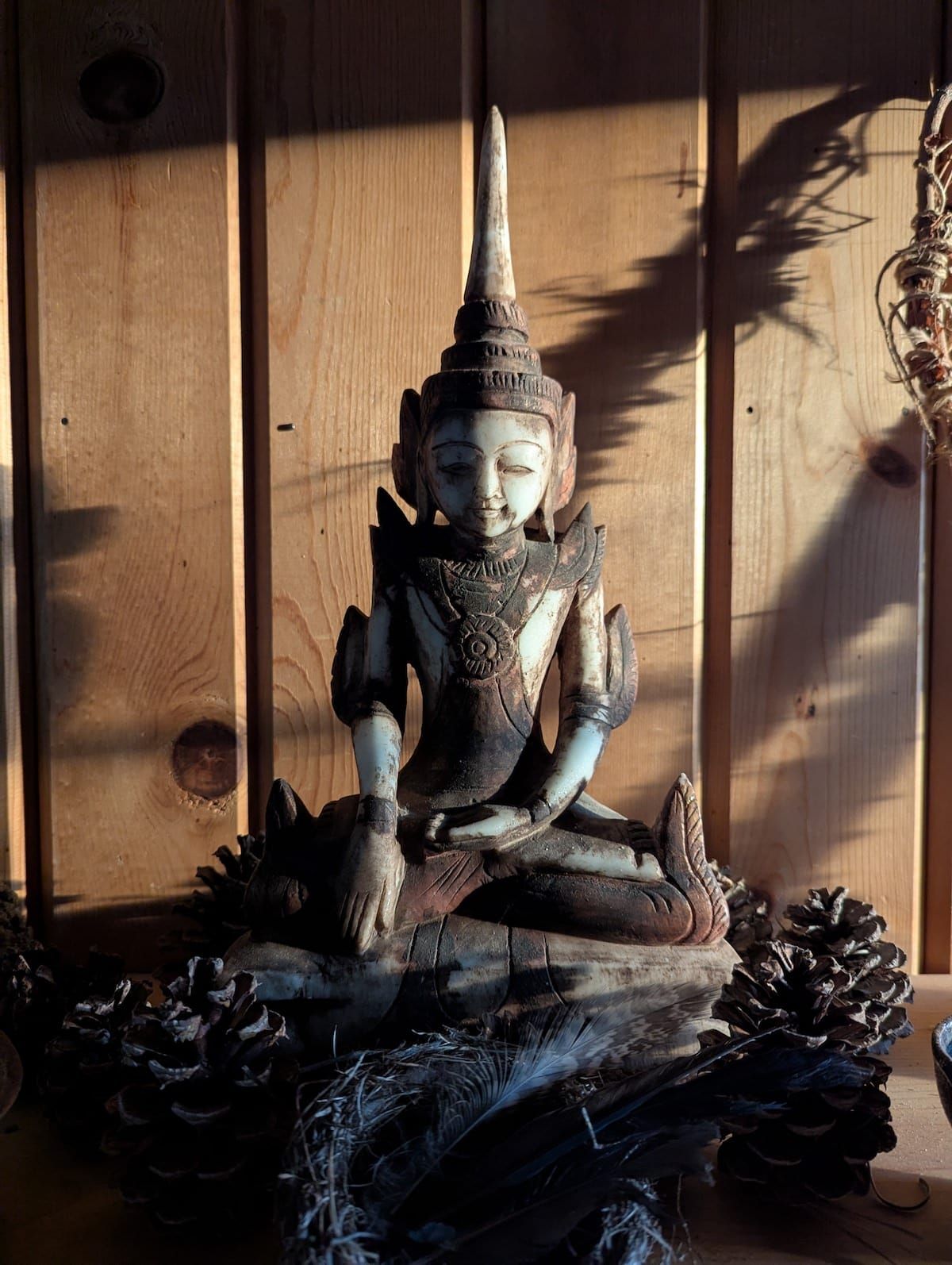
I've always been moved by the story of how the Buddha, when sitting under the bodhi tree prior to his great awakening, was assailed by the armies of Mara, the incarnation of delusion or self-doubt; and in response, the Buddha simply reached out and touched the earth.
Then the earth goddess rose up, calling forth the waves of understanding to wash away the forces of delusion. Deeply unsure of himself, uncertain whether he was doing the right thing, whether he was on the right path, unsure even of what was real or unreal, the Buddha reached out and touched the earth, and instantly found his doubts dispelled, replaced by an unshakable certainty and joy.
We too can touch the earth, just by opening ourselves to the boundless world: the whir of a hummingbird, the splash of orange lichen on gray stone, the scent of green tea. To be completely open is to be completely connected, and when we live like this we find our doubts are simply insignificant in the face of the grandeur of existence. Just touch the earth.
Today one can visit the bodhi tree at Mahabodhi Temple in Bodh Gaya, in Bihar province in India. While the original tree is gone, the tree that stands there now is said to be its descendant, by way of a sapling sent to Sri Lanka by the Emperor Ashoka in the third century BCE. In 1881, a cutting was taken from that tree and planted at Mahabodhi Temple, next to the so-called Diamond Seat or vajrasana, which marks the spot where the Buddha sat.
Now a hundred and forty-five years old, the bodhi tree is enormous, with some of its heavier branches held up by pillars, and millions of pilgrims pass beneath it every year. When a leaf falls, someone will invariably catch it, smiling with delight at this blessing of the tree.
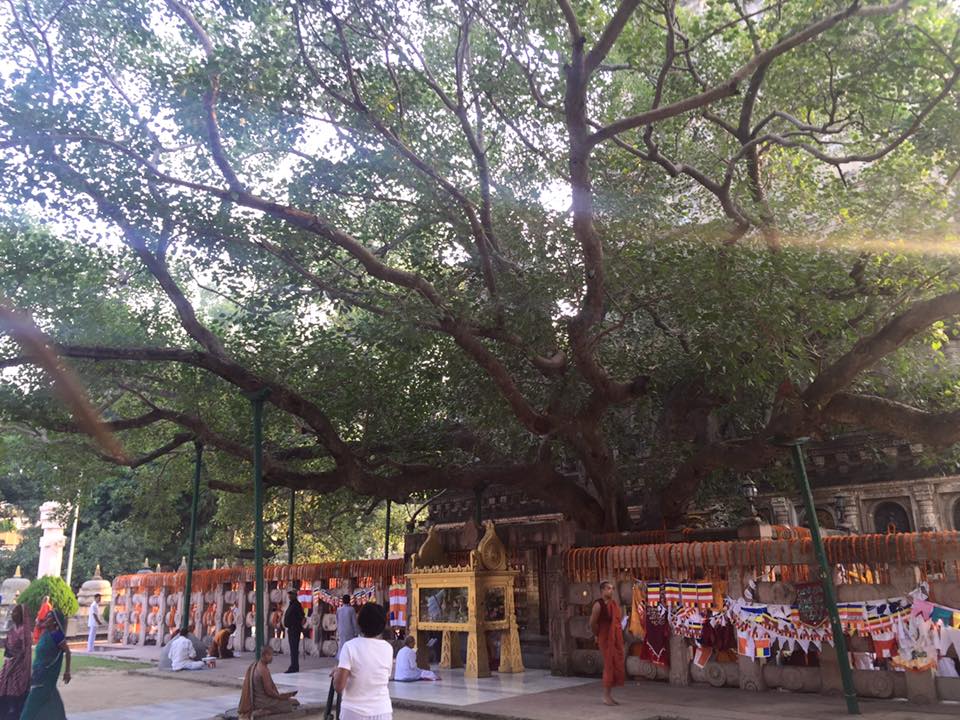
I myself visited Mahabodhi Temple and sat beneath the Bodhi Tree for my fortieth birthday. The trip offered an appealing centering quality, making the pilgrimage to this important place near the midpoint of my life, honoring this path of inner inquiry.
Before going, I imagined a quiet, serene temple, but I found the reality a little different. While certainly there are individuals sitting quietly in meditation, many others come in groups. Frequently they’ll sit by the Diamond Seat and play a talk from their teacher over a boom box, or chant along with a recorded service. I was also a bit taken aback, as I sat under the tree, to be approached by someone who wanted me to come with him to see his community--and presumably make a donation. I’d literally travelled around the world to sit quietly under the tree. Didn’t I deserve a little peace? But his need, and the need of those he served, didn’t allow for many boundaries.
Outside the temple gates, that need was starkly evident. The memory of one beggar in particular has stuck with me, as he seemed to have no lower body, resting his torso in a little cart and moving by simply pulling himself along the ground with his gnarled hands. Many other beggars sat beside him, while vendors selling flowers, pictures and dried bodhi leaves strolled back and forth with their wares, desperate for a sale.
The rest of the town was much the same. While there are many remarkably beautiful temples from around the world--it seems every Buddhist country has a pavilion--the province is poor, and as elsewhere in India, many alleyways are filled with rotting trash and feces from all kinds of animals. In the shantytowns, you walk on planks laid across the filth. If trash collection exists, poor people can’t afford it, and so to get rid of their trash they just rake it into a pile and burn it, whatever it’s made of. Along with open cook fires and the periodic burning of fields for crops, this means the air is badly polluted, and respiratory problems are rife. While essentially all of the temples have outreach and social uplift programs, India seems to be simply too vast and the poverty too great for any easy resolution.
Nor is the place of the Buddha’s enlightenment quiet. To the contrary, like most of India, it’s very noisy. If the pilgrims inside the Mahabodhi complex like to play chanting services over speakers, so do the temples outside, Buddhist and Hindu alike, blasting their services over enormous loudspeakers that resound across the countryside. There’s a great deal of honking and traffic noise as well, and if you’re staying in a hostel, television and loud voices are very common, in buildings with zero soundproofing. To fall asleep I developed a routine of putting in earplugs, putting sound-cancelling headphones over the earplugs, and playing white noise until I was nearly asleep. Then I would remove the headphones so white noise would continue playing on my phone (with my earplugs still in).
Visitors often describe India as overwhelming, or more kindly might call it “a feast for the senses.” Certainly every sense is vividly occupied. The colors are bright, the food heavily spiced, the music loud, the scents unavoidable, the people commensurately forward. Later on in the trip, two other travelers and I were randomly invited to an Indian wedding. To get to the wedding hall, the wedding party marched down the street playing music and dancing, traffic be damned.
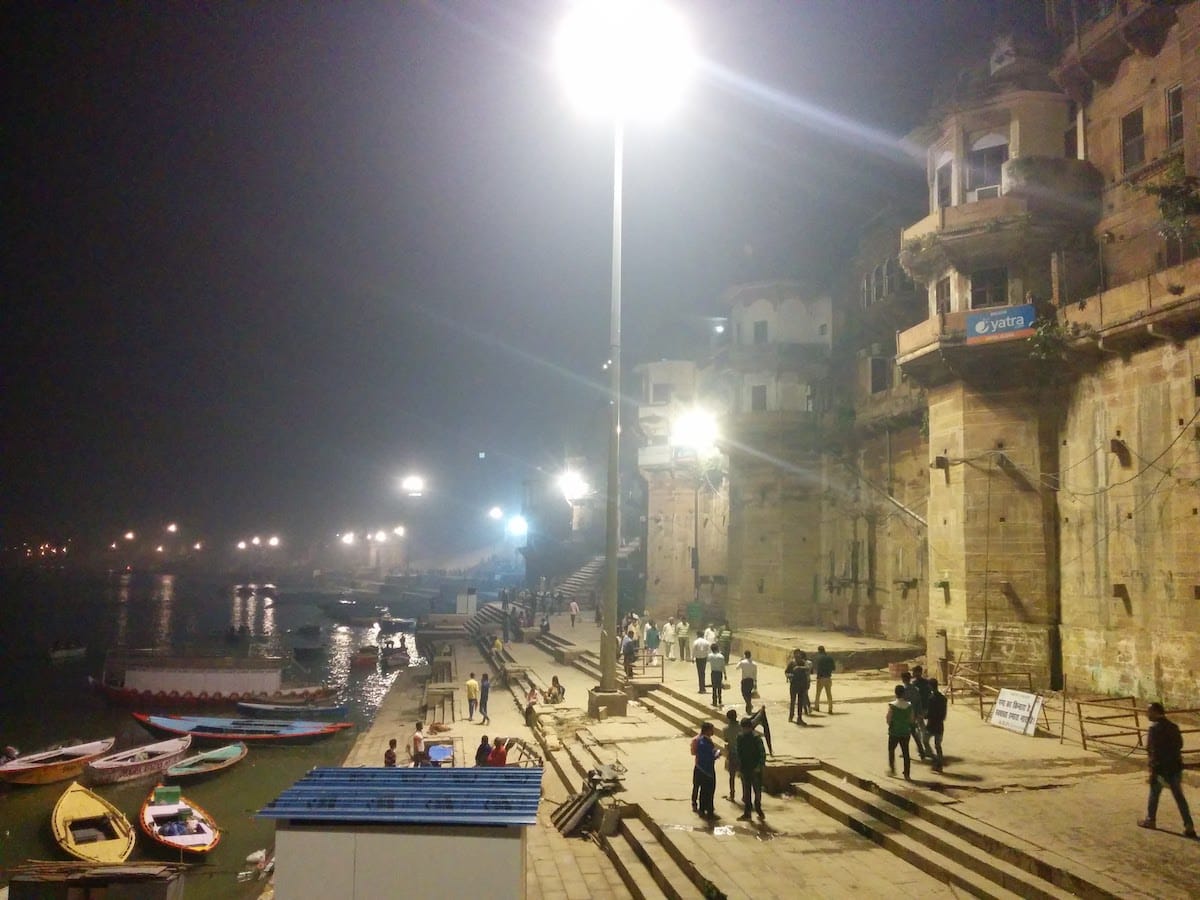
So, it’s not for the faint of spirit. At the same time, there can be a closeness to the heart of things, the understanding that we are living now, we’re completely in it, with no illusions and no time to waste. You can see this at Varanasi especially, where Hindu priests perform cremations on concrete platforms built alongside the Ganges River, burning bodies day and night. You may be sitting in a shop by the steps down to the river, and as you’re drinking your lassi, a party of men may walk by carrying a body down to the river, chanting as they go, the body wrapped in saffron cloth and laden with marigolds. It’s considered rude to take pictures, but it’s okay to quietly watch, and it’s a solemn and soul-stirring sight to see the bodies burning through the night.
It’s said that the Buddha’s search for truth was sparked by seeing an old man, a sick man, a corpse, and a monk. Seeing the transitory nature of life--that all things pass quickly away--along with the possibility of spiritual liberation implied by the dignified figure of the monk, Siddhartha found he couldn’t rest until he too found real and lasting freedom.
After undertaking great austerities, he came to sit under the tree. Sitting perfectly upright, he became like the tree, ancient, steady, uncomplaining, branches reaching for the sky, roots sunk deep in the earth.
Buddhism has many symbols, some of which we’ll explore in subsequent talks; but it may be that the tree is the one I love most. Trees are purely beneficent. Their whole being is growth and giving. Simply by existing, they shelter all. Consider a verse from the sutras:
A large tree with a mighty trunk,
branches, leaves, and fruit,
firm roots, and bearing fruit,
is a support for many birds.
Having flown across the sky,
the birds resort to this delightful base:
those in need of shade partake of its shade;
those needing fruit enjoy its fruit.
Buddhism has a long history of forest practice dating back to the time of the Buddha. In fact each of the great pilgrimage sites of the Buddha’s life are marked by trees. The Buddha was born under a tree at Lumbini; reached enlightenment under the bodhi tree at Bodh Gaya; taught the Dharma in Deer Park at Sarnath; and entered nirvana beneath the sal trees of a grove at Kushinagara, which blossomed out of season with his passing.
The tree provides a paramount example not only of generosity, beneficence and vitality, but also of unselfconsciousness. It supports and sustains all who enter its presence, and requires nothing in return. Thus it presents the perfect image of the bodhisattva.
This calls to mind a famous spot in Ayutthaya, Thailand, where an ancient stone Buddha head is being slowly subsumed by a tropical tree, the face smiling gently out from the embrace of gray, twisting roots. Buddha as tree, tree as Buddha.
In the archeological record, depictions of the bodhi tree precede depictions of the Buddha in human form. In this aniconic depiction, the tree--which is also to say, the place, the site of the Buddha’s enlightenment--is synonymous with both the person and with awakening itself. This is worth reflecting on. When the Buddha reached down and touched the earth, it was a way of asking: What is this? And each time the earth answered: This is you. You are this. The touch of dirt on fingertips: You are this. The sound of leaves rustling in the breeze: You are this. The whine of a mosquito, the scent of wet soil, the rising calls of birds in the morning light: this, and this, and this. This is why the Buddha is also called the Tathagata, “the one thus come.”

We’re not separate from the world. We’re never separate. Modern life and architecture have a way of insulating us from natural environments, but that insulation is a literal construct--the four walls that probably enclose you now. Those walls may afford us protection from the elements, but they don’t change our basic interdependence with the natural world. Extraplanetary settlement may make for good TV, but we should understand that it has about as much relationship to reality as the Lord of the Rings. As human beings we’re completely dependent on the Earth and its ecosystems. Really we’re expressions of it, outgrowths of it. We stem from the earth in the exact way leaves stem from the tree, and thinking we can survive when disconnected from it is like thinking a leaf can survive when disconnected from the branch. This connection is spiritual, but it’s also physical and biological. It’s fundamental to what we are.
Trees are also, of course, literal pillars of many of the richest ecosystems on Earth, and their destruction is closely linked to the mass extinction of species currently underway. When forests are destroyed, innumerable species follow. It’s striking that what some like to call “economic development” is really a process of desertification--taking vibrant forests and turning them into lifeless deserts of concrete and asphalt.
Along with fostering biodiversity, trees are instrumental in sequestering carbon. One excellent way to slow down global warming is to reforest or rewild tracts of land. Conversely, deforestation speeds global warming by releasing stored carbon back into the atmosphere and eliminating the ongoing absorption that living forests provide. Unfortunately, this can contribute to a negative spiral, wherein rising temperatures lead to forest fires, which release more carbon into the air, which leads to rising temperatures.
Global warming, mass extinction, a whirling confluence of crises and catastrophes. Poverty, sickness, old age and death. Our personal worries about relationships, health, money, career, and the way the refrigerator keeps making that loud rattling noise. Maybe you find your nervous system rattling too.
But follow the Buddha’s example. If you feel overwhelmed, return to your senses. Set aside your thoughts and return to here and now. If you can, go for a walk in the woods or a park. Sit against a tree and feel the rough bark on your back. Feel its imperturbable strength. Be reminded: this, and this, and this.

Member discussion: