
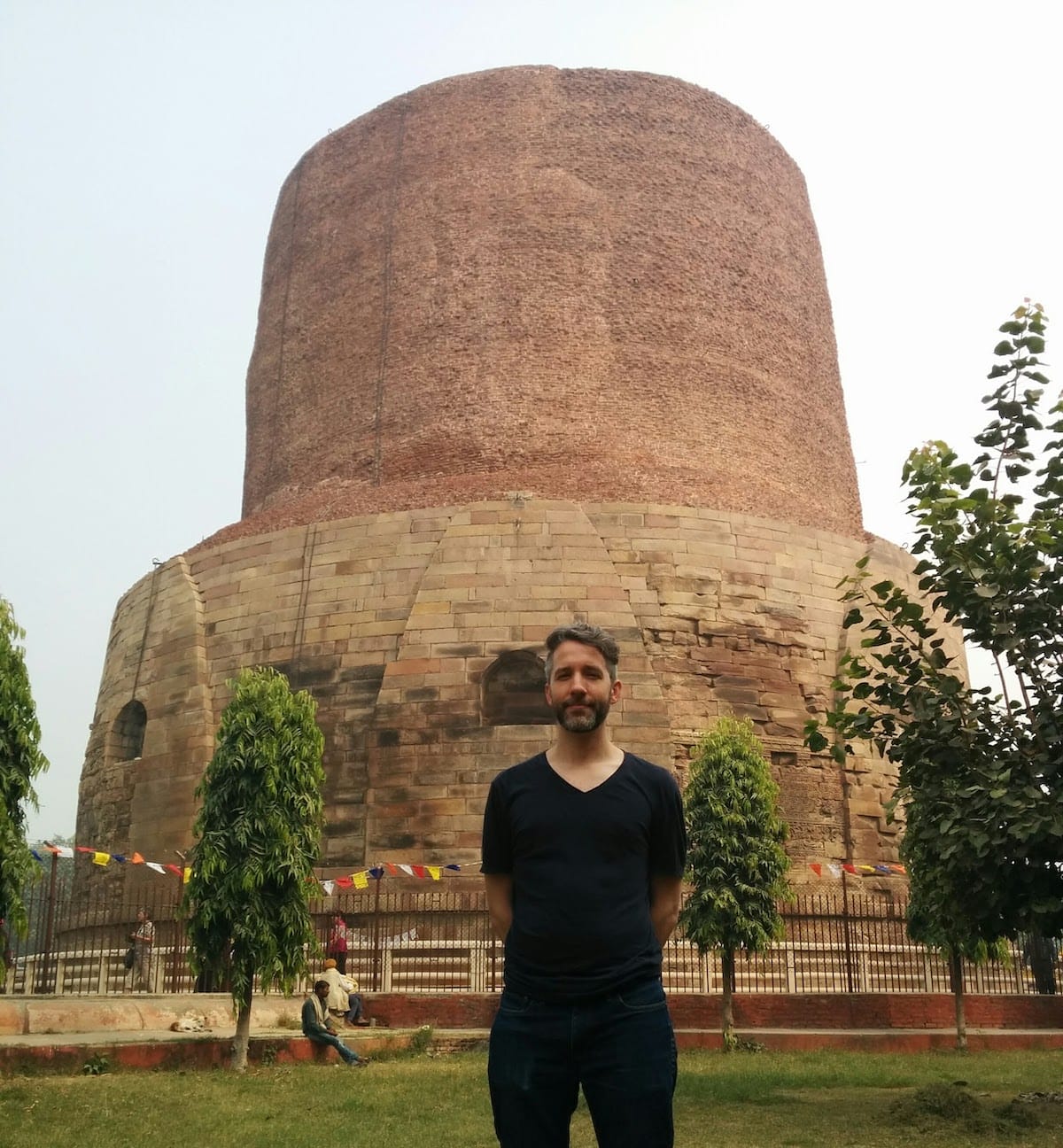
If we wish to understand Buddhism, we might begin at the beginning, with the Buddha’s very first sermon after his awakening: the Dharmachakrapravartana Sutra, “Turning the Dharma Wheel.” Tradition has it that following his great enlightenment, the Buddha went looking for his former companions, five ascetics searching for ultimate truth through self-mortification. Finding them at Deer Park in Sarnath, near Varanasi, he proceeded to set forth the fundamental teachings of Buddhism. Today at Sarnath you may visit the Dhamek Stupa at this very spot, a large round stone edifice circumambulated ceaselessly by pilgrims from around the world, physically reenacting the Buddha’s timeless teaching. (And yes, there are tame deer you can feed too.)
The Dharma Wheel (dharmachakra) carries a deep symbolism arising from early Indian religious concepts of cyclical existence and karma. In ancient Indian thought, particularly within Vedic and Upanishadic traditions, life was understood as a repeated cycle of birth, death, and rebirth (samsara), driven by actions and consequences (karma). The wheel (chakra) was a powerful metaphor for this unending cycle, often depicted as the Wheel of Birth and Death (bhavachakra), which appears in both Hindu and later Buddhist cosmology. The Buddha, adopting this imagery, repurposed the wheel to describe the path out of the cycle—the Wheel of Dharma as the means to transform and transcend the Wheel of Birth and Death.
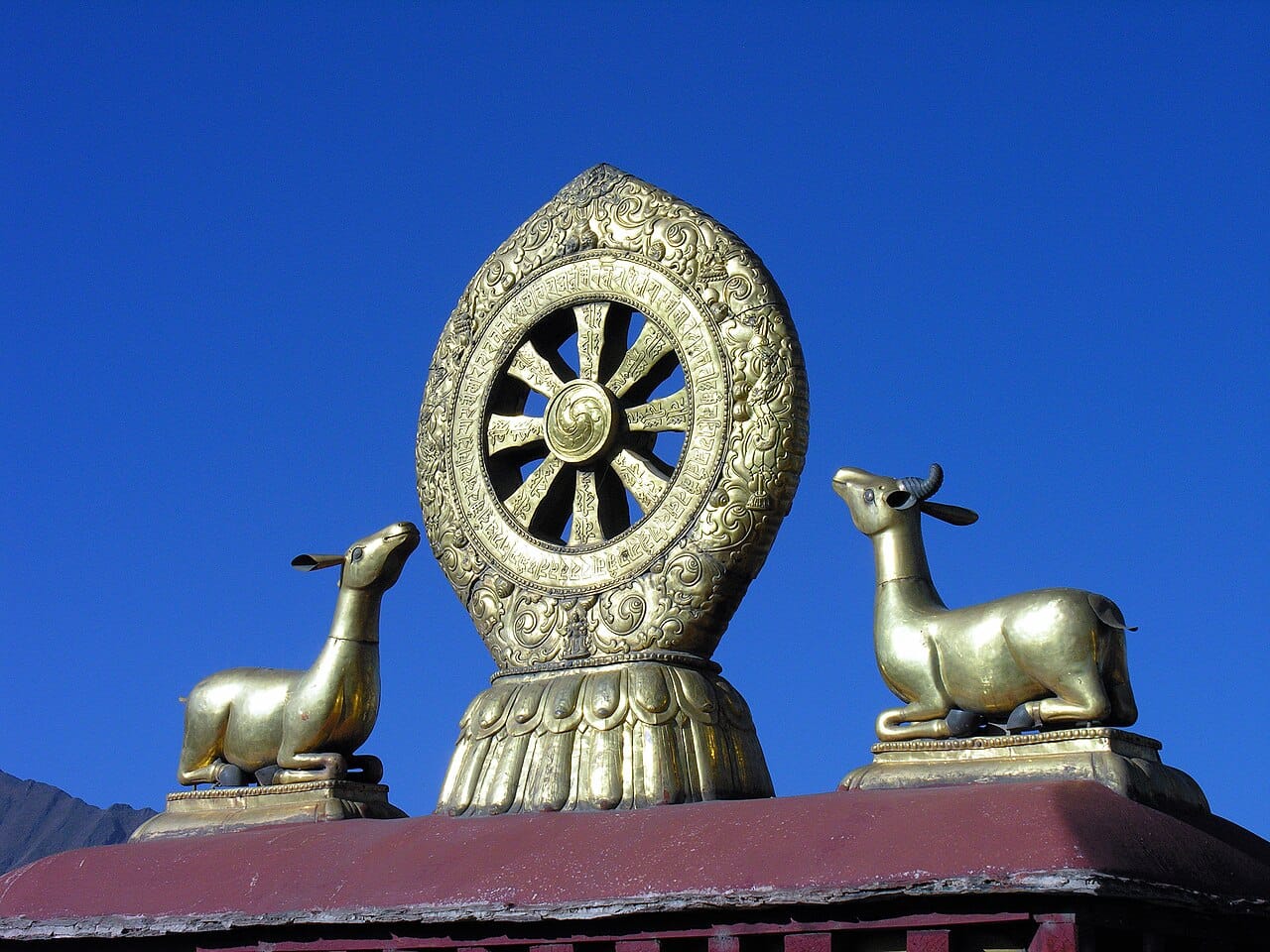
The Noble Eightfold Path is therefore represented as the eight-spoked Dharma wheel. The wheel’s connection to the Eightfold Path is obvious, but less so is its relationship to the rest of the Four Noble Truths, especially the first truth, dukkha: the pervasive feeling that something is not quite right, out of harmony, out of joint, like a wheel spinning out of alignment. Take special note of this latter meaning, which actually is fundamental to the translation of the word dukkha: duh- is a prefix meaning “bad,” “difficult,” or “hard,” while kha, along with meaning “space” or “hole” generally, refers specifically to an axle-hole. Dukkha, then, is the ill-formed axle-hole that is making the wheel of our lives turn askew.
The very first verse of the Dhammapada alludes to this meaning:
All mental phenomena have mind as their forerunner; they have mind as their chief; they are mind-made. If one speaks or acts with an evil mind, 'dukkha' follows him just as the wheel follows the hoofprint of the ox that draws the cart.
https://www.tipitaka.net/tipitaka/dhp/verseload.php?verse=001
This understanding is very different from the common translation of dukkha as “suffering” or “anguish.” It is also far from the popular formulation of the First Noble Truth that “life is suffering,” a sloganistic interpretation handed down from the 19th century that has done tremendous harm to Buddhism in the West, implying that the entirety of life, with all its beauty and wonder, is little more than an endless round of pain and discomfort. No wonder some think Buddhism nihilistic. But perhaps the best and most accurate translation of dukkha is not “suffering," but “misalignment.” The Noble Eightfold Path, then, offers a way to correct this misalignment, to true the wheel so that we can move frictionlessly on the bumpy road of human existence—and all future existences.
There are a few more points regarding the symbolism of the wheel I’d like to consider. We read again from the Dharmachakrapravatarna Sutra:
“The [Blessed One], in Vārāṇasī at the Deer Park of Ṛṣipatana, has turned the Dharma Wheel three times in twelve motions, that all the śramaṇas and brāhmaṇas, and all the devas, māras, and brahmās, have never before turned!”
https://www.lapislazulitexts.com/tripitaka/T0099-LL-satya-samyukta/
The “sramanas and brahmanas” are religious renunciants and priests, while the “devas, maras and brahmas” are divine beings and spirits. The “three turnings and twelve motions” comprise an epistemic framework in ancient Indian rhetorical and philosophical traditions. An argument that cycled through these stages of investigation (the “three turnings” of the declarative, prescriptive, and testimonial modes, applied to each of the Four Noble Truths, making twelve “motions”) was formally called a “wheel.” By calling his sermon a “wheel,” the Buddha was indicating his logic’s exhaustive nature.
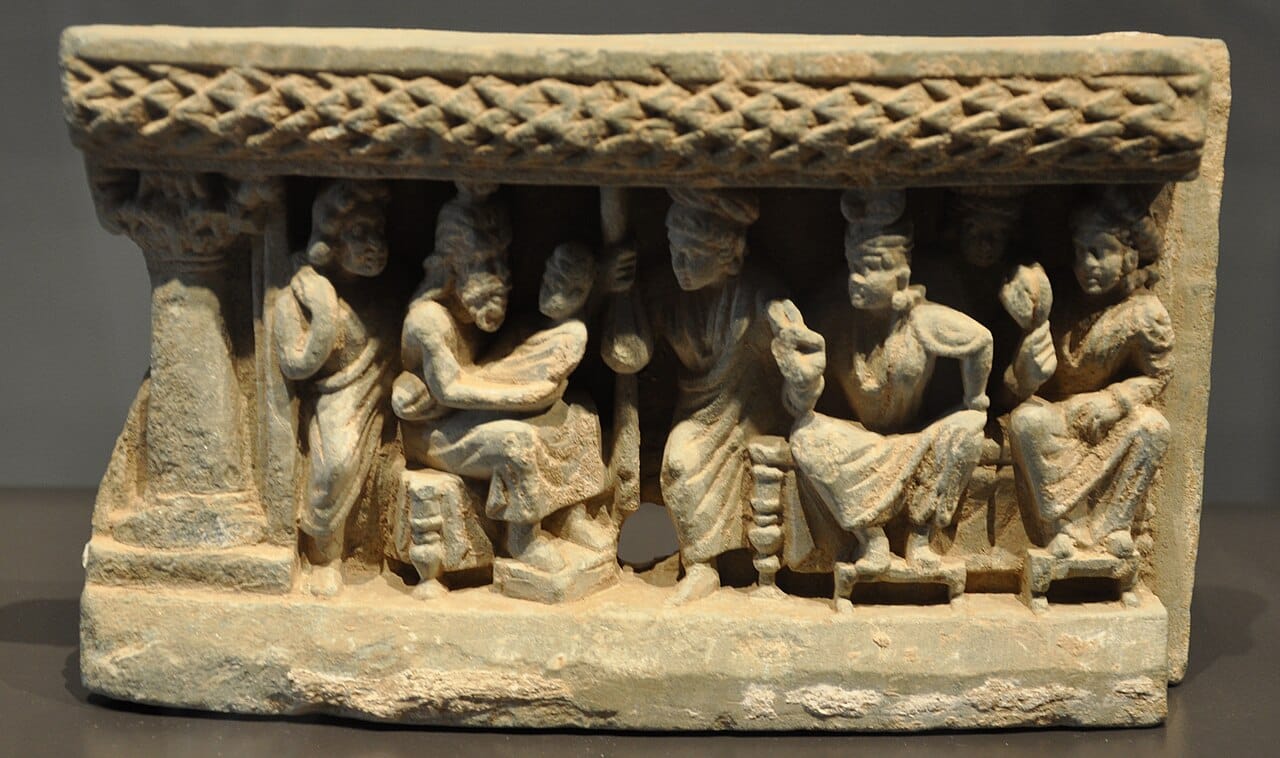
There are also interesting political and prophetic implications to the Turning of the Wheel. Myth has it that when the Buddha was a baby, a seer came to the palace and inspected him, finding thirty-two marks that indicated a great destiny. The seer prophesied that the Buddha would become either a great world-ruling monarch (called a chakravartin, a “wheel-turner”) or he would become a Buddha. By setting the Dharma Wheel in motion in his sermon, the Buddha thus became the “King of the Dharma,” whose teaching conquers the mind.
Finally, the word chakra is likely familiar to you from another context, namely yoga practice, in which chakras represent the energy centers of the body. Thus trueing the wheel also implies the harmonizing of the chakras.
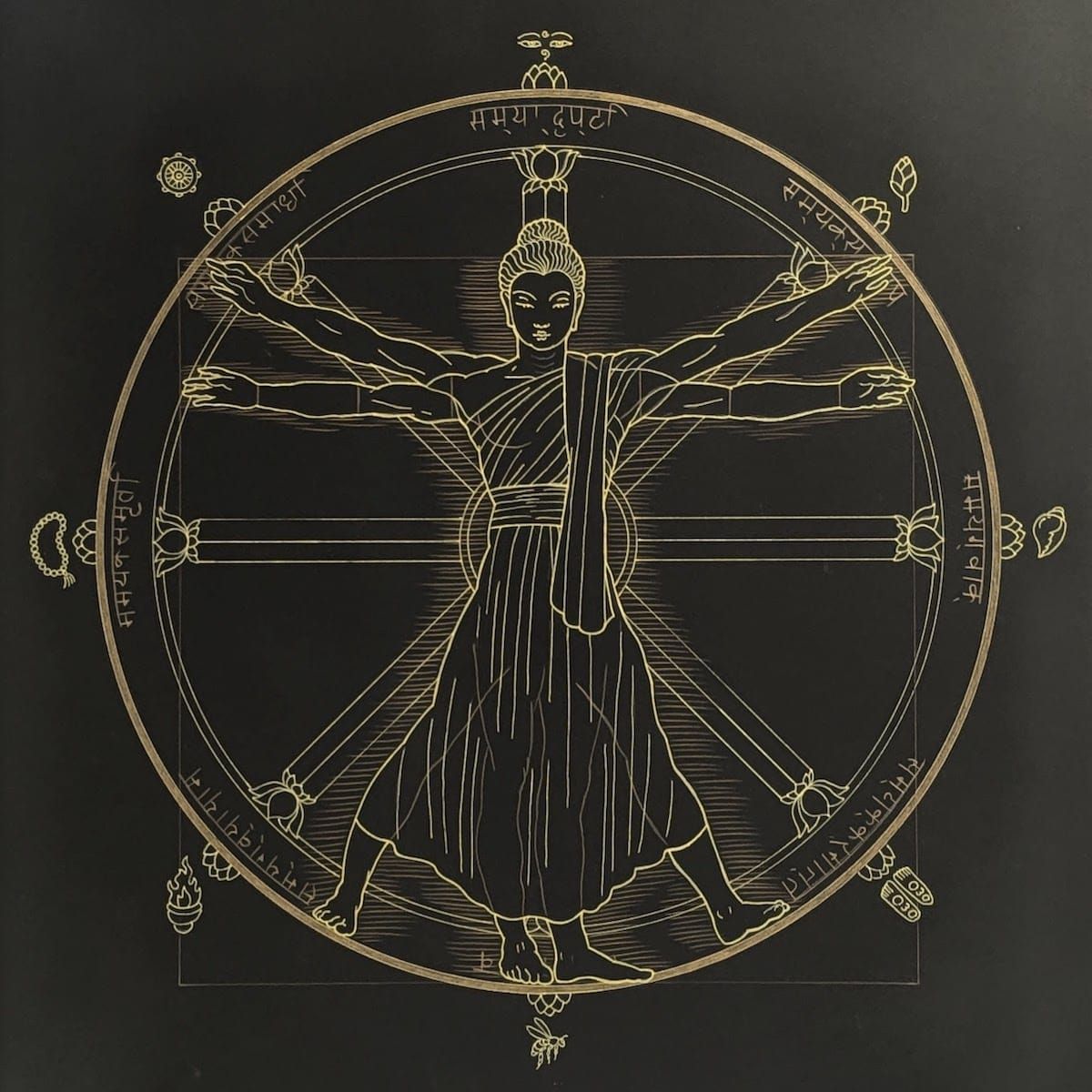
Along similar lines, the Noble Eightfold Path in Sanksrit is Arya Ashtanga Marga. Arya here means “noble”; Marga means “path or “way”; and Ashtanga means “in eight parts” or more simply, “eight-limbed.” We might then call the way of the Buddha the Noble Eight-Limbed Path.
Yoga practitioners may also recognize the word ashtanga in reference to Ashtanga Yoga, this being both a modern style of yoga popularized by K. Pattabhi Jois in Mysore, India, and also--and more relevant to our discussion--a system of classical yoga described in the Yoga Sutras of Patanjali. The Yoga Sutras were composed centuries after the Buddha’s time, and their author clearly either had direct knowledge of the Buddha’s teaching in their creation, or at least partook in a common culture of sramana practice. Thus there are many similarities between the two, and a certain concordance between the teachings.
But setting Patanjali’s Ashtanga aside for now, let’s turn to the Buddha’s Eight Limbs. Here they are, with my translations alongside the originals:
- Samyak Drishti, True Seeing
- Samyak Sankalpa, True Intention
- Samyak Vach, True Voice
- Samyak Karmanta, True Action
- Samyak Ajiva, True Sustenance
- Samyak Vyayama, True Exertion
- Samyak Smriti, True Recollection
- Samyak Samadhi, True Unification
These are, collectively, the fourth and final of the Four Noble Truths, the actual path to free ourselves from disharmony. They were the primary framework for Buddhist training and realization for centuries and remain central in much of Theravada Buddhism.
My own Buddhist background, however, is in Zen; and there, and perhaps in Western Buddhist teaching generally, I find that the Eightfold Path has received short shrift. My own teacher, Robert Aitken, mentioned it only in passing in his primer Taking the Path of Zen. Commentaries on the Four Noble Truths abound, as do commentaries on the Sixteen Bodhisattva Precepts, but somehow the teachings specifically named as the Fourth Noble Truth are repeatedly relegated to a footnote.
This has a great deal to do with the development of Zen, whose inception in China followed many centuries after the Buddha’s time, in a very different culture. Above all Zen taught realization in the here and now, separate from any fixed doctrine, “a special teaching outside the sutras, not reliant upon words and phrases, pointing directly to the mind and realizing Buddhahood,” in Bodhidharma’s famous formulation. The means to this realization was the singular method of zazen, silent seated meditation (a focus that only intensified on Zen’s transmission to Japan). With this emphasis, the study of the classical sutras may have come to seem antiquated, especially as other texts—most notably the Heart Sutra and various koan collections—came to occupy the preeminent place in Zen discourse.
So it is not perhaps surprising that in the West, we find the Eightfold Path deemphasized if indeed not glossed over entirely. Yet while illumination is available to all, always, by dint of our essential nature as the “fabric and structure of existence itself,” to use Alan Watts’s phrase, a failure to understand the Eightfold Path in many ways amounts to a failure to understand Buddhism, at least as it was taught by the historical Buddha. This is naturally a great loss.
Then too, when one does review what modern commentaries exist on the Eightfold Path, it again and again appears represented primarily as an intellectual framework, each spoke considered as a field of mental endeavor, one might say. In this I partially fault the painfully inadequate translation of the original Pali and Sanskrit terms, rich with meaning and history, into English words, which possess a different and narrower set of connotations. These translations especially seem to elide the yogic implications of the original terms. The effect is first, to denude them of their original context, since the Buddha and his disciples certainly understood them in a yogic light; second, to disregard many of the practical recommendations for skillful practice; and third, to deprive practitioners of the somatic qualities of these teachings.
To offer just one example, samyak smriti is most often translated as “Right Mindfulness.” This translation justly reflects the practice of clear sensory awareness in the present moment, which obviously is of paramount importance for Buddhist practice. However, this interpretation entirely neglects samyak smriti’s connection to recollection, which is to say, to memory, regarding recollection as being important solely to “recall” one’s senses to the present.
This is not incorrect; it is merely incomplete. We ourselves should recall that for centuries the Buddha’s teachings were transmitted orally, and so literal, detailed recollection was expected of every monk. One could not, after all, understand the teaching if one could not remember it. In India, as in every ancient culture, memory was highly valued, and monks were trained in complex mnemonic techniques, especially rhythmic chanting and recitation. This is likely part of the reason for the constant repetition and numbered lists common to ancient Indian religious texts. We might then consider how the active practice of memory--True Recollection--could benefit our own minds, and how this kind of embodied knowledge fits into the complete development of consciousness presented in the Eightfold Path.
As I will show in the essays to follow, comparable oversights are readily found in every one of the other limbs. My hope is that sharing them will lead to a more rounded practice and a deeper understanding of Buddhism and ourselves. If we are to train our consciousness, we must do so holistically, with our total bodies, neglecting nothing. It’s a grave mistake to attempt to alleviate our discomfort or uneasiness through mere intellectual striving. Discomfort too is a kind of sensation, and it arises like all the rest as a result of our total somatic state. No thinking will relieve it. To discover the serenity of true meditation, we must practice with every cell and fiber.
I’ll end with a favorite passage from Zen Master Hakuin, one of the great teachers of Japanese Zen. This is from “The Four Ways of Knowing”:
When you see something, shine through it; when you hear, shine through what you are hearing; shine through the five skandhas (form, feeling, perception, will, consciousness); shine through the six fields of sense perception – in front, behind, left and right, through seven calamities and eight disasters, become one with radiant vision of the whole body. See through all things, internal and external; shine through them. When this work becomes solid, then perception of reality will be perfectly, distinctly clear, just like looking at the palm of your hand.
At this point, while increasing the use of this clear knowing and insight, if you enter awakening, then shine through awakening. If you get into agreeable circumstances, then shine through agreeable circumstances. If you fall into adverse situations, then shine through adverse situations. When greed or desire arise, shine through greed and desire; when hatred or anger arise, shine through hatred and anger; when you act out of ignorance, shine through ignorance. When the three poisons of hatred, greed, and ignorance are no more, and the mind is pure, shine through that pure mind. At all times, in all places, be it desires, senses, gain, loss, right, wrong, visions of Buddha or of dharma, in all things shine through with your whole body.
Hakuin on Kensho: The Four Ways of Knowing, trans. Albert Low.


Member discussion: